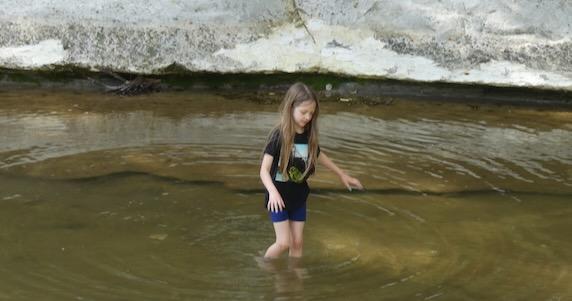
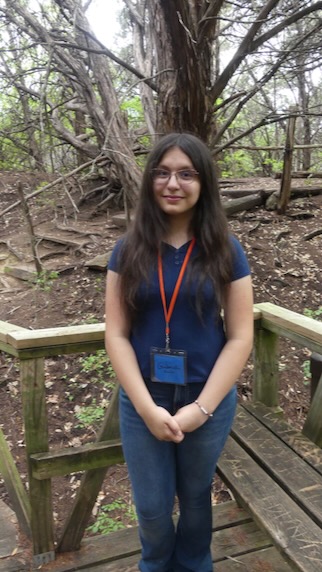
Fourth grader Irene Haynes wades the creek at Ladd Nature Preserve in Duncanville. Photo by Michael Smith.
iThis is the second article in a three-part series on Nature Education.
How do we nurture a nature kid? I’m referring to those kids who love being in nature and often want to learn about wildlife and wild places.
And for those kids lacking that intense biophilia, what experiences can parents, teachers and others provide to open their eyes to the wonder of fields and creeks?
NEED FOR NATURE AND NATURE ENTHUSIASTS
We have seen that all of our kids face many stressors and are at increasing risk of problems with mood and anxiety. And among the various things that could help, we know that time in nature generally reduces stress and leaves people better prepared to deal with daily life. There are many stories of nature as a source of fascination, connection, a sense of safety and a refuge for kids, as well as empowerment.
Since nature is beneficial, most of us want to open the door for those who would like to become “nature kids.” We would do it not only because we care for them, but also because we need nature kids. Who else will carry on as advocates and protectors for unspoiled places when our time is up?
Aldo Leopold pointed out that “There are some who can live without wild things, and some who cannot.” He placed himself among those who cannot, and many of us would join him. But after our generation, it is today’s nature kids who will keep that connection alive, if there are enough of them. We need nature kids and the kids need nature, and the Earth needs all of us.
What kinds of experiences does a developing nature kid need? How much activity should be structured teaching and how much should be nature play? What is important for nature centers, schools, parents and others to teach?
I talked with various teachers, nature program staffers, parents and the kids themselves to get some answers.
WHAT KINDS OF EXPERIENCES ARE IMPORTANT?
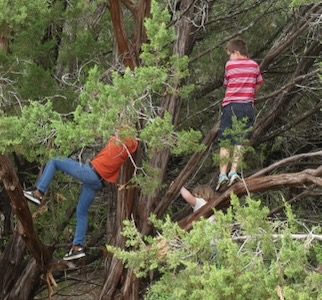
In the beginning, it’s pretty unlikely that facts alone would inspire many kids to love nature. Knowing that an eastern red cedar is really a juniper tree and that most of them grow to 30 or 40 feet is less memorable than climbing those straight limbs like a ladder and sitting there, looking out at the view.
Griffyn West, a sixth grader from Azle, recalls a family trip years ago to Great Sand Dunes National Park and Preserve, hiking up a mountain and later taking off her shoes to walk in the sand dunes. She and a friend go on nature hikes and pretend to be characters from a favorite book series. Griffyn talked about a juniper tree at her grandparents’ property.
“We just climb up the tree and watch for ants or snakes,” she said. “We pretend it’s some kind of secret fortress.”
She likes science facts, too, but the real energy in her connection to nature seems to revolve around sensory experiences and pretending.
Ten-year-old fourth grader Irene Haynes told me that the critters in her front yard were key to the development of her love of nature. Watching a green anole lizard and knowing that it is watching you back can really pull you in. Regarding what draws her to nature, she said she loves the sounds, like when she recently went to Lochwood Park, climbed a tree and heard the breeze. “There are so many cool things in nature,” she said. “I love wading the creek and finding cool animals.”
Irene’s love of nature is more than tree-climbing and other physical and sensory activities.
“I know a lot of grown-ups, especially my mom, who love nature and encourage me in that.”
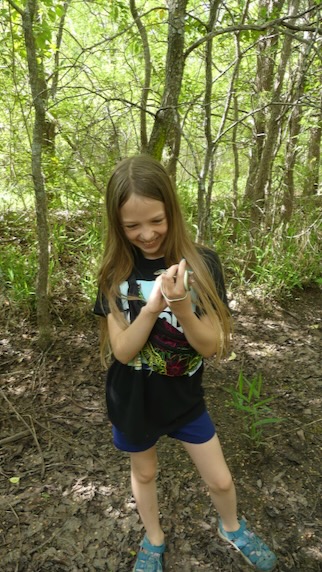
Her mom is a Master Naturalist who homeschools and does reptile presentations for groups of kids. The day that we talked, we walked near the creek at Ladd Nature Preserve in Duncanville. Irene suddenly bent down and carefully picked up a beautiful and harmless ribbon snake. We joked that the musk that many people dislike smells OK to us.
All the naturalists I have spoken with seem to agree that these early experiences of discovery and delight while out somewhere in nature are crucial. Master Naturalist and Wild DFW author and Green Source Texas reporter Amy Martin calls us “creek kids” (herself included). Her formative experiences on White Rock Creek also included pretend elements, much like Griffyn’s. There is some kind of magic at work in the wonder and freedom of playing at the creek.
At a meeting of the First Friday program at the Acton Nature Center near Granbury, I talked with several homeschooled kids about nature.
Sixteen-year-old Gabe noted, “I would consider nature to be part of my identity.”
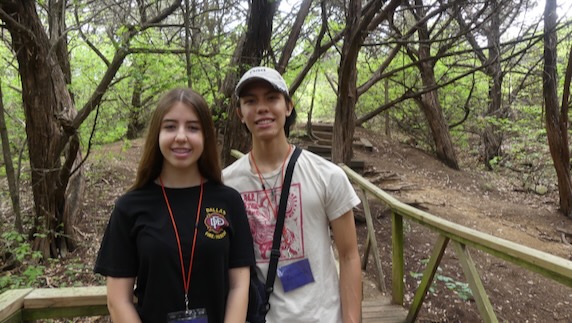
He is a rock climber, but even at the nature center where there are no rock faces to climb, he likes the animals and appreciates the sounds and smells of nature. His friend Louisa, age 15, said that her favorite outdoor venues are wooded places like where we talked that day. She enjoys writing and sketching.
Similarly, 14-year-old Gabriella said she uses her observations for creative writing.
"I pay attention to little details so I can write them in stories — all different kinds of stories.”
Her brother Mateo likes to walk around, see the trees and find interesting things like the fort that the kids had put together from grapevine and tree branches.
When asked about helping kids get in touch with nature, a couple of the First Friday kids talked about the role of phones. Jadrien said it would be helpful to get kids to “stay away from technology for just a little while.”
Gabe said that for a child who is mostly into the internet, adults should intervene with some memorable field trips.
“Take them out on the best day possible — give them a good experience with nature.”
Louisa observed, “There are things that are beautiful and get overlooked because people aren’t paying attention.”
FEAR FACTOR
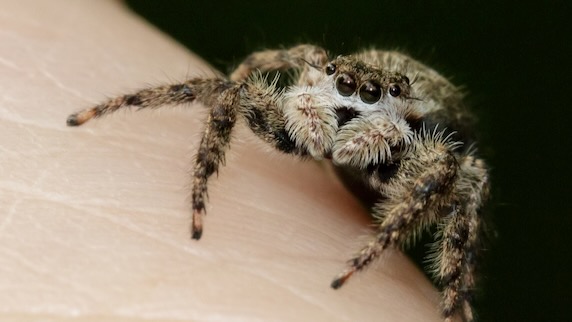
The kids I spoke with were mostly consistent about the kinds of things that could limit a child’s enjoyment of nature. Gabriella talked about fears of insects, spiders and snakes, though such concerns don’t keep her indoors.
“I’m fine with insects as long as they’re not trying to get me.”
Jadrien said that in nature there is tall grass and there might be snakes.
Louisa could not think of much to dislike about nature, but maybe it would be cockroaches.
When asked what gets in the way of people getting out in nature, Griffyn’s answer was bugs.
“Some of the boys and girls in my class, if they see a spider they want to kill it. If I see a spider — I don’t particularly like spiders — but I’m not gonna kill it.”
Irene agreed that bugs could be a nuisance.
“I do not like giant bugs. We were out mothing one night and a giant longhorn beetle decided that my face would be the best place to go.”
But that would not keep her inside.
“There are lots and lots of things that can outweigh it, tons of cool things to find.”
The kids’ perceptions are true for lots of people. When researchers look at what ranks highest among nature fears, spiders and snakes are at or near the top.
HOW DOES LOVE OF NATURE START
An unanswered question, as far as I can tell, is whether there is an early window for nature experience that will translate into a deeply-felt love or curiosity. And does that window close forever after the child grows up? I’m sure we could find at least some examples of people who developed a meaningful love of nature as adults. Is that the exception to the rule? Is the connection formed by nature kids deeper or stronger, on average, than a connection that begins in adulthood?
The Children and Nature Network summarized a British study showing that connection to nature was generally stronger before the teenage years. The study’s takeaway was that we needed ways of specifically appealing to teenagers on behalf of nature. The results also lend some support to that idea that nature experiences need to happen when we are young, though they certainly don’t prove that they must happen during that period.
In my own life’s trajectory, I was a museum kid and a creek kid through childhood. Then I was distracted by rock and roll and girls for some of my teenage years. But just like in the British study, my interest in nature became stronger again in adulthood. The unanswered question is whether that resurgence in interest and love would have happened had I not had important nature experiences during childhood.
It’s important to talk with kids and look at their experiences. When I talked with Irene and Griffyn, they mostly described playing in nature — climbing a tree that became a fort, wading the creek and finding frogs, feeling the sand and water, hearing sounds and seeing beautiful things. Movement, sensation, discovery, experiences of beauty and awe — all of these seem to be common threads in how kids come to love nature. As much we want to teach nature facts, we have to remember how critical these experiences are.
Such experiences also fit with our understanding of child development. When teens are asked how they came to love nature, they remember exphttps://www.wdcschool.org/abouteriences at an age when kids’ activities center on tangible objects, pretend play, how things around them work and can be named and classified. Before adolescence, they are not yet primarily dealing with the world through abstract concepts.
SUPPORTIVE PEERS AND MENTORS
Supportive adults are also important factors in developing a love of nature.
Irene mentioned encouragement from adults.
“I met a lot of my friends in nature,” she said.
Peer groups and teachers (including parents) are probably essential. Jadrien thought it would be helpful if parents could take their child on a nature trip:
“Just you, the child and nothing else.”
There’s something about the attitudes of teachers, parents and peers that may be implicit but should be made explicit. If the adults and peers around a child talk about nature as something valuable, with lives deserving of respect and compassion, that is what the child will learn. If friends get excited about finding something interesting or beautiful and try not to harm it, the child is likely to adopt that way of treating nature.
When I visited the West Dallas Community School and spoke with nature studies teacher Esther Villareal, she talked about encouraging care and respect within the school’s Christian perspective. She said she tells them, “God made animals; we want to respect them and care for them. We are not here to be destructive.”
It’s important to her to “see their hearts turn away from the idea that this is here for my entertainment, nature exists to serve me, make me rich.”
She wants her kids to see themselves as stewards of creation.
Villareal talks with her kids “about the food web and the fragility of life.”
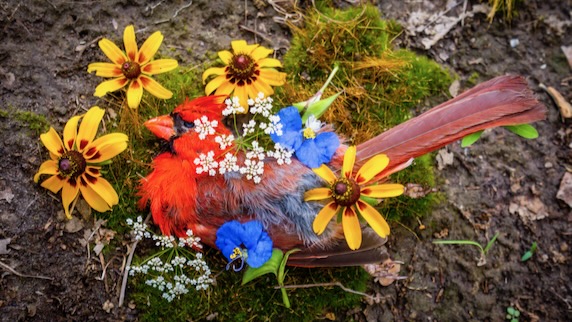
On one of her walks with the kids, they found a dead cardinal.
“The kids wanted to pick flowers and bury it with flowers.”
When one of the students went home and told her dad, he shared photos by Austin anthropologist and artist Amanda Strong, who constructs beautiful memorials to animals that have died. Villareal’s students are learning the respect and compassion that I believe is a crucial part of being a nature kid.
PRESERVES VS PLAY AREAS
Those of us who have a hand in nurturing these nature kids have a number of ways we could go about it. We could take them to prime examples of woodlands, wetlands, prairies and such places, and teach them the names of birds or insects and the relationships between living things. Or we could make sure that playgrounds and schoolyards have natural features and let the kids direct their own play and discovery. We could show them how to grow what we eat and how to garden in ways that don’t harm the land or even help heal it.
My conversation with Laura Haynes, a Master Naturalist and mother of Irene, illustrated how we can borrow from several of these strategies. She and her husband each grew up in smaller, more rural communities but wound up in Dallas.
“When my kids were preschool age, we spent a lot of time outside because my husband and I both had a very strong sense that those had been formative experiences for us,” said Haynes.
But they knew that, living in Dallas, they would have to work at providing nature experiences. They live in a house that backs up to a creek and have brought in logs and planted things to create wildlife habitat in their yard. Because they homeschool their kids, their yard is the schoolyard.
She says it’s important to take kids to pristine preserves as well as nature venues where kids can just play.
In a sanctuary or refuge, the surroundings are more “hands off” so that the natural features can stay natural.
Haynes said she had the benefit of both as a child.
“Growing up, I was the one kid on 15 acres,” said Haynes. “Whereas at Cedar Ridge Preserve there are thousands of people who come through and so they have to have a different set of rules in order to keep it from being loved to death.”
Their family loves being on trails in a nature preserve, and Irene really soaks up the natural history part of it. But there are limits to the experience.
“If a kid comes away thinking that nature is like an art museum where you look but don’t touch, they’re less likely to actually build a relationship with nature. And the real goal is a relationship,” Haynes said.
For children, such relationships are built in a hands-on way.
The children need places where they can climb, build forts, catch tadpoles and so on. We can let that happen in play spaces that do not have to be preserved just as they are. What’s needed is something between a bare playground and a nature refuge. Maybe a small creek and some trees, logs to look beneath, and permission to re-arrange things just a bit. We need spaces like that, just as we need spaces that we protect from being “loved to death,” as Haynes said.
REAL-WORLD EXPERIENCES AND MYTHBUSTING
One of the protected spaces that gets lots of love, with a little bit of hands-on but rules to keep it wild, is the Fort Worth Nature Center and Refuge. Michael Perez, the Natural Scientist Supervisor and one of the educators, talked about the importance of spending time in wild places like woods and prairies.
He told me, “It’s different, reading about the forest and all the different layers, as opposed to going into the forest, hearing the wind, the sound of the leaves when the wind’s blowing, seeing the grass wave in a prairie, seeing the water ripple. You’re immersed in it, you’re part of it, you’re connected with it.”
And additionally, he believed that hearing from experts during such visits can dispel myths about nature. In their educational activities, they may ask a group of kids to rate an animal that might be considered dangerous or “icky.” They decide if they like, dislike or are not sure about the animal. Then staff talk about how the animal lives and what benefits it may bring. And perhaps on a hike they will see one, like the time they found a western rat snake on the trail. At the end of the activity, when they ask the kids for their ratings, there are fewer dislikes. Recalling the nature kids I talked with and their statements about bugs and snakes being a possible downside to nature, such teaching is important.
BACK TO THE GARDEN
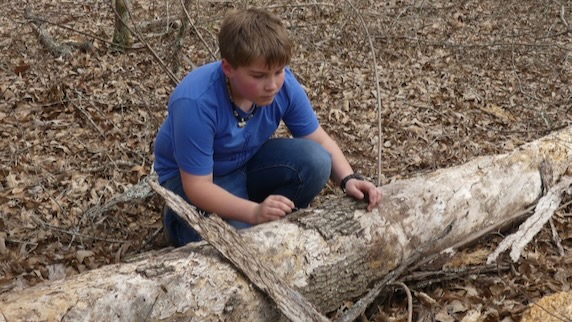
To learn more about regenerative agriculture, I visited Learning Gardens near Athens, Texas. It is the brainchild of Susie Stillwell and Austin Walsh, who bring kids to the woods, ponds, and a plot of land where they grow crops.
“At the Learning Gardens, we teach kids the importance of native plants and animals while also teaching them how to grow their own food,” Stillwell said. “When a kid gets the satisfaction of harvesting a zucchini, we talk about the importance of pollinators and how we, too, get to benefit from a healthy ecosystem. Regenerative agriculture has a focus on healing the land and improving it.”
While visiting Learning Gardens, I asked Thomas, an 11-year-old, how he got interested in nature, and he told me about how he enjoys visiting his relatives who live out in the country. He said one attraction of the outdoors is that “there’s so much to do.” It’s a statement that reveals what has become familiar to him and what he knows well enough so that he sees all its potential offerings. A child who was into screens and video games might say that there is so much more to do indoors, because that’s where the things he likes can be found. A guy like Thomas has evidently learned about the outdoors and come to love the things nature offers and therefore sees a lot of things he’d like to do there.
ROLE OF MEDIA
What about the use of media? Griffyn mentioned the PBS show Wild Kratts as one positive way to get kids connected with nature. In the show, the Kratt brothers highlight the “creature powers” of various wild animals. It is a mix of real video and animation, playfully teaching nature facts.
Griffyn said, “I think there should be more documentaries and maybe podcasts for kids to listen to about nature, and how it’s not as scary as we think it is.”
THE NEXT STEP
In the first article we discussed what’s going on with kids and why engagement with nature can be helpful. Now we have talked about how a love of nature might get started and what kinds of experiences help a child deepen their interest in and love for nature.
The next step is to take a further look at the programs, clubs and teachers around North Texas who are working with kids to connect them with nature. That includes programs like Kids on the Prairie that led the way in getting kids connected with nature, as well as larger-scale programs like Camp Fire First Texas’ El Tesoro summer camp. We’ll step into a day at Learning Gardens or the Twelve Hills Nature Center in Dallas and see some activities. And we will look at forest bathing, experiencing nature through the senses in quiet walks in the woods, such as what is offered by the Slowtrails.
NATURE EDUCATION SERIES:
PART 1: WHY KIDS NEED NATURE TO COPE WITH MODERN LIFE — NOW MORE THAN EVER
PART 2: WHAT SHOULD WE TEACH KIDS ABOUT NATURE?
PART 3: LOCAL NATURE EDUCATION OFFERINGS - COMING SOON