
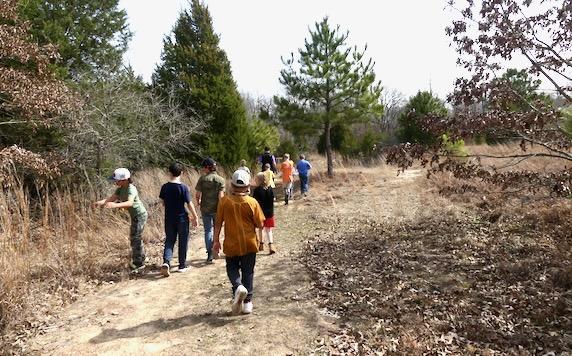
Kids on a nature hike at the Learning Gardens. Photo by Michael Smith.
This is the first article in a three-part series about nature education.
After I spent my preteen years being mentored by biologists and naturalists at the Fort Worth Children’s Museum, I was a pretty serious "nature kid." When my family moved from Fort Worth to Corpus Christi, I had a letter of introduction to the director of the Corpus Christi Museum. I wound up going with staff and netting sea horses and anemones in shallow coastal waters and finding Texas tortoises in the thorn scrub. I hung out at the museum nearly every day that I was not in school.
I owe a tremendous debt to both museums. Today, I love discovering programs that offer kids the kind of experiences that changed my life.
That’s why recently I set out to talk with teachers and students about how we might encourage and support nature education, especially for those “nature kids,” who are already drawn to the green and wild world.
NATURE KIDS
By "nature kid," I mean a child who loves being in the woods and other natural places. They enjoy looking for the critters that live there and learning all about them. Researchers who study how nature affects us are finding that it has multiple benefits for our physical health as well as our cognitive and mental health.
My friend Jenna is a grown-up nature kid, and I talked with her some time ago about how this happened. At age five, she caught a Texas spiny lizard.
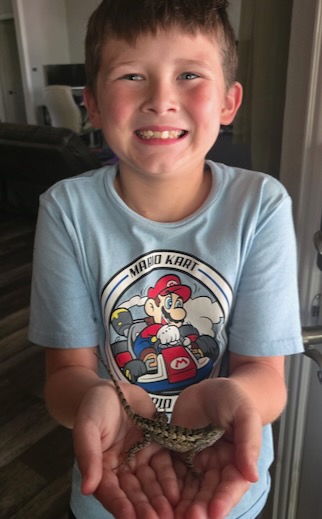
“I don’t know how — they’re not slow,” she said. “My mom freaked out, and my dad was like, ‘oh, that’s cool.’ That’s how it started.”
She was particularly drawn to snakes and lizards, and her parents each found ways to be supportive.
“Even if she didn’t understand it, mom would put me in little kids’ nature hikes at River Legacy, which I loved,” Jenna.
We also talked about her relationship with nature generally.
“When I think about going out and enjoying my surroundings it’s like an escape. Nature is calming, it’s beautiful, kind of like it sucks all the stress out of you when you’re there.”
She talked about nature providing sustenance for her.
“I can feel a connection with all the natural things around me. It’s why I like running around barefoot — it feels good to have the ground on my feet.”
THE BUILT WORLD AND MODERN ANGST
Lots of people feel the same sort of connection with nature that Jenna described. And yet our society is becoming more and more removed from walking in the woods, fishing at the edge of a pond or running through prairie grasses.
Most of us live in the cities now. In the late 1800s, three-quarters of the U.S. population lived on farms and other rural areas. Living “out in the country,” a person’s everyday life was likely to include creeks, fields and animals. But now, four out of five Americans are urban dwellers. Our lives tend to be dominated by the “built” world of roads, buildings, cars and gadgets.
The gadgets — our phones, TVs, tablets, video games and computers — seem to occupy the majority of our time and attention. The American Association of Child and Adolescent Psychiatry reports that the average child age 8 to 18 in the United States spends 7.5 hours a day on these devices. All these screens can bring us valuable information and contact with others. Used carefully and for limited hours, they can be great. On the other hand, they can bring kids into contact with violence or inappropriate sexuality, bullying and exploitation. And they often pull us and our kids away from real world friendships and from time spent outside.
These disadvantages of screen use are only part of the troubles that many kids are facing. Some of the significant problems include gun violence in schools and communities and online bullying. Kids nowadays are indulging in too much screen time and enjoying too few face-to-face social relationships.
Meanwhile, society is experiencing a fracturing of the social institutions that, however flawed, promoted shared truth and values. Current levels of income inequality mean that ordinary people find it harder to have things like secure jobs, housing and medical care that their parents may have taken for granted, and older kids often expect that it will be harder for them, too. The losses and fears that families had to bear during the recent Covid pandemic linger in the memories of most older kids.
WORLD ON FIRE
Further, young people are aware of the degradation of the environment that supports our lives. That degradation results in the loss of increasing numbers of species and a climate crisis that threatens all of us.
All these things sometimes overwhelm the adults or else send us into denial. Many of us spend sleepless nights and worried days, or we’re like the dog in that meme, drinking coffee while the room burns around us and saying, “This is fine!”
Young people certainly pay attention. As more school shootings happen, some say that they don’t feel safe at school. When Swedish activist and student Greta Thunberg organized Friday school walkouts to protest inaction about the climate crisis, hundreds of thousands of kids joined her. The kids see what’s happening, and not many are saying, “This is fine.”
If these issues are too much for us to cope with, they certainly exceed the kids’ developmental and emotional skills.
Many experts are reporting a mental health crisis among our young people, with increasing levels of anxiety, depression, hopelessness and suicide.
THE BALM OF NATURE
At the same time, kids often have less access to — and sometimes less interest in – nature, which could offer help with stress and may boost attention, emotion regulation, and physical health.
Familiar places in nature can offer a sense of stability that is hard to find in a world that can seem unpredictable and unstable, and many kids speak of nature as a refuge. Beyond that, contact with nature has been shown to lower anxiety, stress and depression in adults and children.
There are studies comparing nature settings with settings in the built world, and we do better and feel better in the nature setting. We generally have less anger and sadness and greater attentiveness.
Time spent in the woods, prairies and creeks, for many kids, is like a preventive medicine or therapy that is both free and fun. Nature will not make the troubles of the world go away, but it contributes to healthier and less stressed young people.
LOCAL EXPERTS WEIGH IN
I talked with Debra Atkisson, MD, DLFAPA, DFAACAP, PCC, a board-certified child and adolescent psychiatrist who serves as the senior vice president of Clinical Services for Blended Health Services.
“Our kids today have multiple stressors that their parents or grandparents did not have,” she said. “So it’s difficult for us to assist them because they’re facing challenges we didn’t face.” Among the stressors are social media and being bombarded with media generally, as well as the loss of civility in society at a time when children need good models of how to regulate their emotions.
Regarding climate and environmental worries, Dr. Atkisson said she has talked with a few bright children from age 10 to preteens who are aware of the issues like climate change.
“A child was talking to me who had anxiety about the fact that there are species becoming extinct, and she said, ‘If that could happen to them, it could happen to us, too.’”
Dr. Atkisson added that it is an artificial life for us to be predominantly indoors.
“We are meant to be in nature, we are meant to be moving, and that helps us be more present and mindful and helps us relax.”
At Fort Worth Nature Center and Refuge, Michael Perez added another perspective on how nature can benefit kids. Perez, the natural scientist supervisor at the Nature Center, said that they offer a program with overnight camping and canoeing for inner city kids. As one group got off the bus, he saw the cool kids hanging out together. The last boy to get off the bus didn’t appear to fit in with the clique.
Perez helped the kids pair up and board the canoes. A cool kid paired with the guy who didn’t fit in was suddenly frightened.
“There’s a spider! A spider, Mr. Michael, in the canoe!”
The misfit tried to reassure him: “It’s OK, it’s all right.”
He gently caught the spider in his hands and released it outside the canoe.
And then someone else discovered a spider in their canoe, so the “spider whisperer” made his way over to this other one. Once again, he fearlessly but gently caught the spider and relocated it.
He was no longer the rejected kid. That night, when the group was camping, when they heard a strange sound, he was the one that the other boys turned to for reassurance. Outdoors, in his element, the boy was fearless and capable, and it changed how the rest of the boys saw him.
For him, an ecologically sensitive person, being in nature was empowering.
KIDS IN NATURE MOVEMENT
The 2005 publication of Richard Louv’s book, Last Child in the Woods was a watershed moment for recognizing the nature deficit crisis and the need to get kids outside. Among the things that emerged from it was the forming of the nonprofit organization Children and Nature Network (C&NN) in 2006. The organization advocates for kids to have equitable access to greenspace and shares information including research on how time in nature affects kids.
Then, in 2009, a bipartisan group of Texas legislators asked several state agencies to address kids’ access to nature. Texas Parks and Wildlife Department, Texas Education Agency, the Texas Department of State Health Services and the Texas Department of Agriculture formed a public-private partnership called the Texas Partnership for Children in Nature. That partnership became, in 2021, an independent nonprofit called the Texas Children in Nature Network (TCiNN).
The organization’s website states that it is comprised of more than 900 partner organizations across the state that “self-organize” into regional collaboratives. The TCiNN executive director, Sarah Coles, told me that there are 11 of these regional collaboratives that meet regularly during the year. Their members include individuals, school districts, zoos, museums, nature centers, hospitals and others. The organization’s mission includes insuring “access and connection to nature for ALL children in Texas.”
The emphasis on “all” refers to efforts to see that everyone, including historically marginalized kids, can spend time in nature.
“More research is coming out that says being outside is really important for our attention,” said Coles. “Attention Restoration Theory says kids need to spend time outside so that when they get back into the classroom they’re ready to learn, are more engaged.”
When I asked about the right amount of structure, that is, how much outdoor free play is good and how much teacher-led activities are needed, she emphasized the needs of younger children.
“The younger they are, the more unstructured it should be," said Coles. "At ages three through six they are learning a lot through unstructured exploratory play. When you are that young, your brain is developing at such a high rate that the unstructured time is very important.”
SEEDS OF LEARNING
One Dallas program featuring that sort of self-directed play is Seedschool. The program, led by director Kate Stuart features lots of outdoor time. For indoor activities, she uses a converted school bus named Matilda. On the day that I visited, the kids finished some activities in the bus and went out to play. A number of them gravitated to an area with soil for planting, and they poured water on part of it, undoubtedly learning in that hands-on, experiential way about how water channels itself downhill, how heavy and sticky mud is, and other aspects of how the physical world operates. Her multi-age group of kids from four to nine years old plants gardens, cares for chickens, and independently comes up with projects on which to focus their learning.
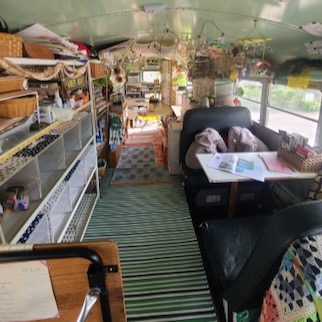
“It’s most important that kids have the opportunity for discovery, and that is so much easier to do outdoors in nature,” Stuart said,
She noted that she has seen nature programs structured in a regimented way.
“But we all learn better when the learning is self-directed.”
Another important issue that may limit kids’ opportunities for time in nature is a parent’s fears that something bad will happen if a child is allowed to do risky play.
“They might look like they are running wild, but there are parameters or guidelines,” Stuart said as we watched her kids. “There is some discussion upfront about expectations and boundaries.”
And she encourages freedom within those boundaries.
“Risky play is something that is important for children to experience,” she said. “Children are protected and hovered over so that they don’t know how to take care of themselves.”
In Richard Louv’s The Last Child in the Woods, he makes the same argument that children need opportunities for play that runs the risk of bumps, bruises and frustrations in order to become independent and self-confident.
Stuart went on to say, “We don’t want them to get hurt. Certainly if a child is stuck and afraid or frightened I will help them. But first I would try to coach them through.”
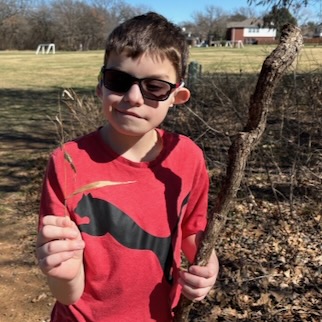
Other programs use a mix of unstructured exploration and at least a semi-structured teaching of concepts and facts. I saw this in a visit to The Learning Gardens, a program teaching about nature and regenerative agriculture near Athens, Texas. I also heard about such teaching when talking with the originators of Kids on the Prairie, an innovative program created by the Friends of Tandy Hills Natural Area in Fort Worth, that went out of its way to bring in kids who don’t get so many opportunities to experience nature.
SERIES CONTINUES
Future articles in this series will highlight these and other examples of North Texas programs that connect kids with nature. The articles will offer ideas about how kids come to be nature kids and what the educators believe is important to teach.
Part 1: Why nature is important for children
part 2: What needs to be taught and what experiences are valuable? Coming Soon!
part 3: Who is introducing or teaching nature to kids, and what do they do? Coming Soon!
NATURE EDUCATION SERIES:
PART 1: WHY KIDS NEED NATURE TO COPE WITH MODERN LIFE — NOW MORE THAN EVER
PART 2: WHAT SHOULD WE TEACH KIDS ABOUT NATURE?
PART 3: LOCAL NATURE EDUCATION OFFERINGS - COMING SOON