
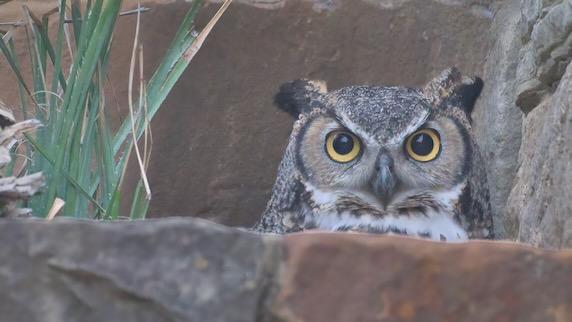
Athena the Owl is back for a new season at the Lady Bird Johnson Wildflower Center in Austin. Photo by Bill J Boyd.
The owl cam at Lady Bird Johnson Wildflower Center is the slowest reality show you’ll ever binge watch.
Surprisingly full of plot twists, the Great Horned Owl Cam at the Austin-based nature center can be gripping.
Athena the owl has been nesting at LBJWC for 16 consecutive years. She perches high above the entrance to the courtyard in a built-in planter. The stone shelf she chose is shaded and sheltered by a drooping sotol plant, offering a picturesque setting.
The live stream was launched in 2024 in partnership with the Cornell Lab of Ornithology. It’s not the blood and guts drama of your typical nature show.
“We expected to see more gore,” admitted Scott Simons, director of marketing and communication, who spearheaded the project. “It’s a lot more sedate, peaceful.”
The nest cam mostly reveals the slow pace of domestic life.
“I turn on the cam every morning when I have coffee,” Simons said. “It’s a balm, it’s a tonic.”
CAM TAKES FLIGHT
Simons said when he was hired at the Center three years ago, there was no owl cam.
The staff noticed Athena but because her nest is so high, they only saw glimpses of the drama unfolding. Getting a camera set up became Simons’ first initiative.
He said they worried they might scare the owls away, so they contacted the Cornell Lab of Ornithology for advice.
“They assured us that the right camera would not affect anything,” he said
Today, the camera is mounted just 10 feet across from her penthouse apartment. The Hollywood-worthy close up of Athena allows viewers to see not only the details of her face and feathers but the first appearance of eggs, owlets hatching, feeding and fledging. The camera runs 24 hours a day, using infrared technology to illuminate the night hours, when the nocturnal creatures are most active.
Staff and volunteers from the Cornell Lab of Ornithology monitor the livestream remotely, sometimes zooming in or out to catch action outside out of the frame.
“If you see the camera moving, that’s Cornell,” said Simons, regarding the cinematography.
MARCH MILDNESS
We got hooked on the owl cam last April.
I was surfing for a channel for my cats when I discovered it. Athena had just hatched two chicks.
The timeline goes as follows. Every year, she shows up at the nest in late February or early March. Soon after, she lays one to two eggs. (In 2015, she laid three.)
She sits on the eggs for about a month.
While she’s incubating eggs, Athena is almost entirely dependent on her mate bringing her food. (He remains nameless and appears in cameos.)
Once Athena lays her eggs, she only leaves the nest for some “me” time off camera. She sips water, stretches her wings, grabs a bite and throws up an owl pellet (privacy, please!).
One time, a volunteer noticed Athena standing by the courtyard pond under a waterfall.
“She looked like a tired mom under the shower,” Simons said.
After the eggs hatch, together Athena and her mate hustle to feed their young.
Round the clock room service consists of mostly rat carcasses, the occasional squirrel and rabbit parts.
Athena brings in the prey clutched in her huge talons. She rips off bits of food with her beak for the chicks, who gobble the morsels like little piranhas.
Left to their own devices, the owlets bend and pull in vain any food left for themselves to manage, lacking her strength and skill at shredding.
Mom makes meal prep look easy.
HIGH DRAMA
While Athena gets top billing in the live stream, the chicks provide comic relief. They also create cliffhangers — literally — as the season wears on.
Their antics include getting stuck on the wrong side of the sotol plant, teetering dangerously close to the nest's edge and biting off more than they can chew.
One evening, one of the owlets was gulping what at first I thought was a snake. Turned out to be a rat’s tail. The chick had swallowed the tail halfway down, leaving a fat piece dangled out of its mouth. “OMG, the bird is choking on a snake!” I said. Frantically scanning online comments, I wasn’t alone in my fretting.
Simons remembered the rat tail incident, that thankfully was digested.
“We are going through what everybody else who’s watching is going through,” he said.
Simons said they rarely intervene, preferring to show nature as it unfolds.
However, viewers should take comfort in knowing that LBJCW will call on the folks at Austin Wildlife Rescue or the Cornell Lab of Ornithology when tricky issues arise.
One dilemma did spur action, when a owlet fledged, landing on a hot busy sidewalk in the event center.
“We chose to very carefully move a pop up tent over it,” Simons said, per Austin Wildlife Rescue's advice. “Just to keep it shaded for that day.”
LEAP OF FAITH
Over five to six weeks hatchlings grow up. The owlets sprout feathers, appear more steady and are left alone for longer periods, all in preparation for taking the biggest leap of their life.
Spoiler alert — the first take-off doesn’t always happen gracefully.
Last year, mid-May, around 3 a.m. one of owlets was dawdling around close to the edge. To my and other viewers' horror, the little guy lost his footing and went over the side.
That’s how it happens sometimes, the experts say.
“Owlets often leave the nest before they can fly well, a process called ‘branching,’ posted @CornellBirdCams to reassure viewers.
The remaining hatchling seemed stunned to see his sibling go over the cliff in a barrel. And he wasn’t keen to join him.
Seven days passed — an eternity in owl-cam time.
Finally he said “oh, what the heck.”
And he jumped.
It was bittersweet.
After just two and half months, we were empty nesters.
NEW SEASON
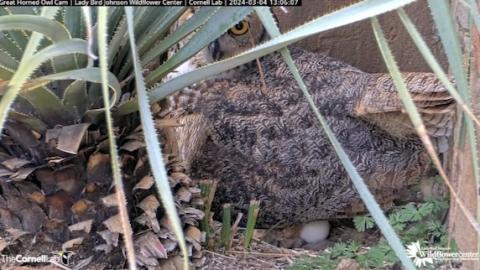
But now it's the start of a new season! Athena returned to her nest on March 4. She laid her first egg March 5 and the second egg on March 9.
For now, she’s spending her days keeping her eggs warm. After about a month of incubation, they’ll be ready to hatch.
Following the owls last year, made me realize that two birds in one sotol plant are a lot of work. And where do all these owlets go?
“We have almost 300 acres, said Simons. “Owls are territorial so there are other owls on the property. The owls we see could be her children or they could be her neighbors.”
As for what draws people to the owl cam?
“I just think people are capitivated by seeing the owls up so close," Simon speculated. "We’re accustomed to seeing owls at a distance. That’s how humans for millennia have interacted with owls. This camera has removed that barrier.”
The technology encourages learning and researching but also inspires kids and adults to bond with nature, he said.
Plus, a mother owl guarding the gate seems fitting for a facility named for Lady Bird Johnson.
“The camera is complementary to our mission,” Simons said. “It’s been arguably the most rewarding project I’ve worked on.”