
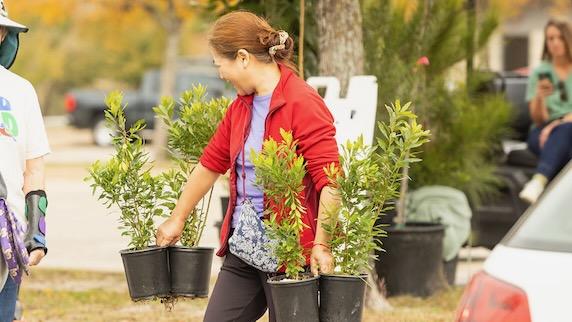
A College Station resident takes home free trees at a city tree giveaway event. Courtesy of City of College Station.
As the temperature heats up across Texas, residents in College Station can be thankful for a tree-planting program underway that aims to mitigate the city’s heat island effect.
Launched in 2024, Cooling College Station aims to not only lower the city’s temperature, but help conserve energy, improve water and air quality, beautify neighborhoods and boost property values.
“Tree canopy loss in College Station currently outpaces replacement, but the program seeks to accelerate replanting efforts,” said Laurie Brown, a College Station Parks and Recreation supervisor. “The goal is a 10-degree temperature reduction under each shade tree.”
HEATING UP
It all started in September 2021 when the College Station City Council directed its staff to research urban heat islands and determine costs for mitigation strategies focused on tree planting. The city’s departments of Utilities, Fire, Water and Parks and Recreation gave their input.
According to the Environmental Protection Agency, urban heat islands happen when cities replace natural land with dense concentrations of pavement, buildings and other surfaces that absorb and retain heat. This increases energy costs for air conditioning, air pollution levels, heat-related illness and mortality.
Like many growing cities, College Station’s expansion has increased concrete and hard surfaces, intensifying heat and warming the city’s troposphere. The hottest conditions are felt most in treeless areas, said Brown.
TAKING ROOT
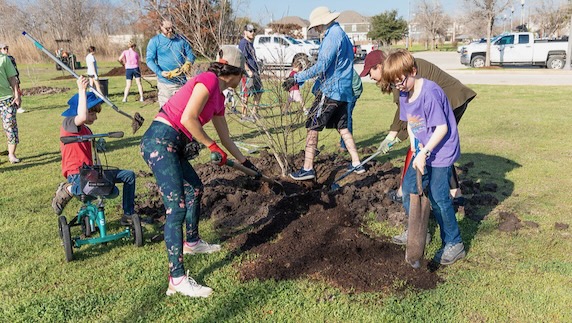
The city’s plan Is to plant 4,800 trees on city property over the five-year program. The plan also called for giving away 2,500 trees to residents. With residents planting and caring for new trees, that's a total of 7,300 trees being added to the city's tree canopy over the course of the program.
In 2024, College Stations’ Parks and Recreation staff began planting trees, organizing volunteers, working with contractors and giving guidance on native trees and tree diversity. Conservation Advisory Group also provided support.
Funding for “Cooling” College Station comes from city council allocations, donations and grants. A grant from Texas A&M Forest Service provided $86,603 for three 2024 projects.
“The goal for ‘cooling’ College Station is increasing its tree canopy in areas where people live, work, recreate and travel,” said Brown. “Priority is given to neighborhoods with foot and bicycle traffic, Low-income areas and areas that show extreme heat.”
To date, the city has planted more than 1,500 trees of various sizes —from 15-, 30- and 95-gallon containers.
In addition, 3,050 seedlings in 1-gallon containers have been planted or given away in residential neighborhoods to encourage residents to plant and care for their own trees.
All giveaways were in partnership with Trees for Houston, a nonprofit dedicated to planting trees in Texas communities.
Tree species chosen for the program include: cedar elm, American elm, American sycamore, Shumard oak, bur oak, Mexican buckeye, Eve’s necklace, Mexican plum, Texas persimmon, cherry laurel, sugarberry hackberry, Texas redbud, eastern redbud, shining sumac, bluejack oak, blackjack oak, red maple, desert willow, wax myrtle, loblolly pine, willow oak, overcup oak, river birch, western soapberry, and native pecan.
These species were selected to promote diversity, provide wildlife habitat for pollinators, insects, bats and birds, and support existing native tree communities. The selection is tailored to Brazos Valley and specific parks where they are planted.
Trees planted in parks will receive watering, pruning and ongoing management by city staff.
In hot or dry areas, irrigation systems are installed to ensure survival. Some larger trees have been intentionally planted to improve resilience and long-term success.
COMMUNITY ENGAGEMENT
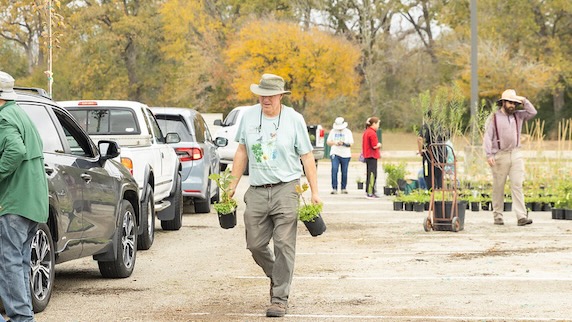
With the help of hundreds of volunteers, the city has planted 108 Texas native trees in W.A. Tarrow and Bee Creek parks, 76 trees in College Station Old Cemetery with support from the Conservation Advisory Group and Aggie Replant and 484 trees were planted in eight parks and two municipal areas.
Brown said the program’s continued success could not have been done without volunteers, supporting nonprofits and homeowner participation.
“Community engagement is critical to address the urban heat island effect and create a cooler environment,” said Brown.