
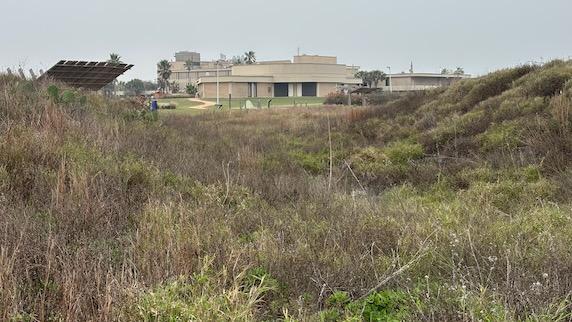
The campus of the University of Texas Marine Science Institute in Port Aransas features a 3.6 acre coastal preserve. Photo by Karl Thibodeaux.
When I signed up for a trip with Green Source Texas for the Whooping Crane Festival last month, I expected to learn about whooping cranes, but I discovered a lot more, including that Port Aransas is much more than a beach town!
The Port Aransas area is brimming with conservation programs, nature preserves as well as advanced education of future scientists.
As festival goers, we toured the educational and research hub of the community — the University of Texas Marine Science Institute, the oldest and most significant marine research facility on the Texas coast.
Founded in 1941, UTMSI is a part of the University of Texas at Austin, College of Natural Sciences, and houses the UT Austin’s Department of Marine Science for undergrad and graduate studies. Today, the facility is home to cutting edge research, education and outreach programs
UTMSI contributes to monitoring and increasing knowledge about ocean ecosystems worldwide. It is also Texas’s first permanent marine laboratory.
Inside the building there are numerous aquariums with fish, other marine animals and plants. Other displays show maps of the area, charts, and explanations of various marine science topics.
NATIONAL ESTUARINE RESERVE NETWORK
Among its projects, UTMSI monitors the Mission-Aransas National Estuarine Research Reserve, a large contiguous complex of wetland, terrestrial and marine environments named for the two river systems that flow into it.
Located on the Texas Coastal Bend 30 miles northeast of Corpus Christi, the Texas coastal reserve encompasses 185,708 acres. It includes three types of environments: terrestrial, marine and wetland.
Habitat found in this reserve includes tidal flats, seagrass beds, mangroves and oyster reefs. The site also serves as the winter home to the critically endangered Whooping Crane.
It’s part of the National Estuarine Research Reserve (NERR), a network of 30 coastal sites designated to protect and study estuarine systems in collaboration with and service to surrounding communities across the U.S.
WETLANDS EDUCATION CENTER
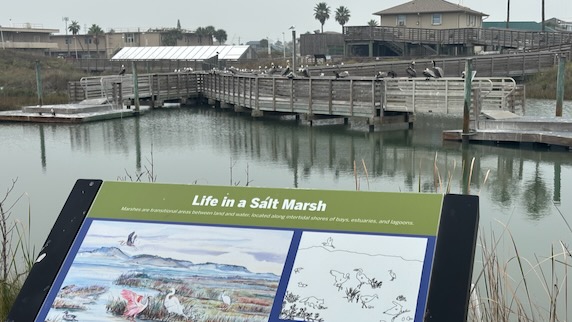
During our visit to UTMSI, we toured the campus Wetlands Education Center. The 3.6-acre coastal ecosystem includes a trail with interpretive signage to help visitors learn about local coastal habitats.
Free public guided tours are offered every Tuesday and Thursday at 9 a.m. and run for approximately 45 minutes to one hour.
Our tour leader explained that local wildlife included coyotes, deer, gophers, possums, raccoons, snakes, as well as other animals and a variety of birds. She pointed out dunes, covered in vegetation which prevents them from blowing away and explained that the Texas barrier islands protect the mainland from the full force of hurricanes.
PUBLIC EDUCATION
In 2005, UTMSI began publishing a monthly column about science and the sea in Texas Saltwater Fishing Magazine. That seed grew, and now UTMSI hosts a radio program called Science and the Sea, as well as podcasts. UTMSI makes these radio programs available to a much larger audience by distributing the programs to both public and commercial radio stations all over the U.S.
Public lectures are offered weekly from January to March. These are open to the public and available on the website and YouTube. There are also other programs in Port Aransas and at Bay Education Center in Rockport.
CARING FOR COASTAL ANIMALS
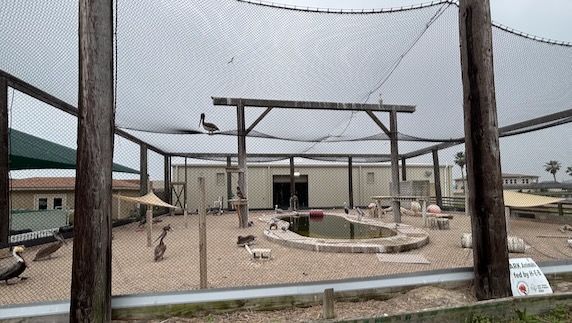
UTMSI also houses the Amos Rehabilitation Keep, known as the ARK. In 1982, the ARK was founded by Tony Amos, a researcher there at the time.
In 2025, more than 1,700 patients were admitted to ARK.
On our tour, I enjoyed a presentation by one of the animal rehabilitation technicians. Following are some of the take aways from the presentation:
There are numerous reasons for animals being admitted as patients to the facility including injuries from jetty entrapment (especially for turtles, which sometimes results in pneumonia); entanglement, (which can cause wounds or infections for numerous animals including pelicans, turtles and great blue herons); collision; gunshot wounds (typically hawks, owls and other raptors); contaminants in water (including oil); and food related illness, resulting from humans giving wildlife non-natural (for the animal) food.
“Feeding fish carcasses to birds definitely leads to internal GI perforations, pouch tears in pelicans, esophogeal trauma and various other issues,” said Andrew Orgill, certified wildlife rehabilitator and ARK staff supervisor. “Pelicans normally plunge dive into schools of smaller fish, such as anchovies and mullet and swallow many small fish at a time. These larger fish that naturally live deeper in the water column are not part of their normal diet.”
Natural phenomenon such as hail storms can also seriously injure animals such as birds. In a severe 2025 hailstorm, more than 400 pelicans were admitted with fractures.
Natural debilitation, parasites, and exhaustion are other causes of animal admission.
In 2025, some of the top species admitted to the center include the following:
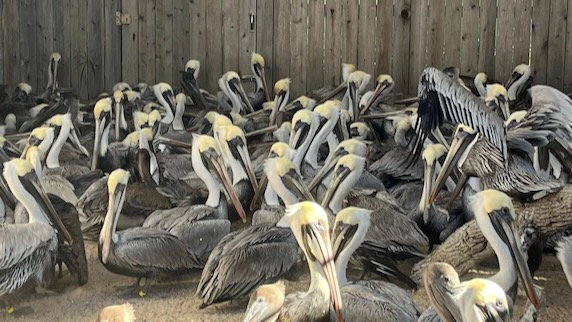
Sea turtle patients admitted to the ARK include: 63 Kemp’s ridley, 49 loggerhead and 471 green sea turtles for injuries caused by entanglement, jetty entrapment or related infections.
Bird admissions in 2025 included 514 brown pelicans and 64 laughing gulls. Birds that are brought into the ARK are banded before release.
The staff also work with endangered species and with animals affected by natural disasters in the area.
The ARK website indicates they have tours as well as volunteer and internship possibilities and various community activities.
LOCAL HOT SPOTS
All the different entities and activities happening at the UTMSI make it an important center of learning and connecting people, animals, and the sea to further science, learning, conservation awareness and conservation activity. I had no expectation before arriving that the trip and UTMSI would have so much to offer. There is something here for people of any age and any knowledge level.
Besides the many functions the UTMSI has and the many opportunities it offers to visitors, the town of Port Aransas has its own charm and attractions. Along with several Green Source Texas members, I enjoyed dining in several restaurants of various cuisines all with pleasant atmospheres and friendly service. We had lovely drives through neighborhoods with rows of different colored houses on stilts that were located on or near canals. There were spectacular ocean and beach views. We visited multiple bird watching locations in Port Aransas and took a boat ride that included wildlife sighting alerts, in real time, provided by our very knowledgeable captain. We saw a few whooping cranes, albeit from a distance. Thank goodness for binoculars and telescopes!
Read more articles from the trip:
GREEN SOURCE TEXAS FLOCKS TO WHOOPING CRANE FEST. Green Source Texas and friends headed south last month to check out the 2026 Whooping Crane Festival in Port Aransas.
CONSERVATION ROCK STAR HEADLINES WHOOPING CRANE FESTIVAL. The festival kicked off with author and whooping crane photographer Michael Forsberg.