
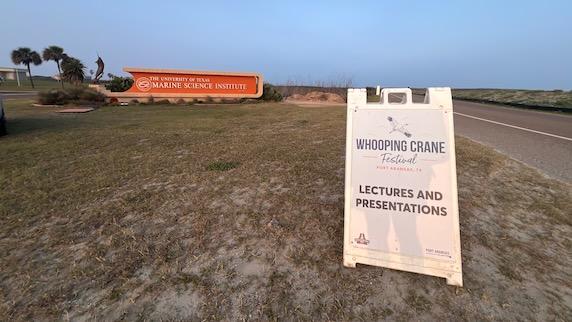
Author and photographer Michael Forsberg kicked off the weekend festivities. Photo by Thomas Johns.
Last month, Green Source Texas and friends headed south to check out the 2026 Whooping Crane Festival in Port Aransas.
On Friday night, we squeezed into a roomful of craniacs at the University of Texas Marine Science Institute’s Patton Center to hear the guru of crane conservation Michael Forsberg deliver the keynote.
The wildlife photographer, author and faculty member from the University of Nebraska–Lincoln, spoke at the soldout event.
A mesmerizing storyteller, Forsberg spun tales of whooping crane lore and anecdotes aimed to school newbies and inspire bird lovers into action to protect the endangered birds.
According to a source at the event, Forsberg was being filmed in coordination with Cornell University for a potential PBS documentary.
DECLINE AND RISE

During his talk, Forsberg relayed the tragic history of whooping cranes in North America. Although the big birds were once widespread across the Great Plains, their populations declined in the late 1800s and early 1900s, when pioneers cleared land and drained wetlands for farming. Whooping cranes were also hunted for their feathers, prized in the fashion world.
In 1946, the National Audubon Society put biologist Robert Porter Allen in charge of their whooping crane project. His task was to learn what their requirements were for survival and to sway public sentiment. To observe whooping cranes at the Aransas National Wildlife Refuge, he built a “dummy cow” to conceal his presence.
“The birds seemed unafraid of grazing livestock, so Allen stretched canvas over a frame to make it look like a cow, painting it reddish brown to match the local herds of Santa Gertrudis cattle,” according to Audubonmagazine.
At that time there were only 16 whooping cranes wintering on the Texas coast.
Allen didn’t know where they were coming from. He put out flyers asking people to let him know when and where they saw them and used the information to start a migration map. But he was still not able to locate their nesting grounds.
A breakthrough came after helicopter pilots from the Canadian Forest Service spotted a pair of whoopers with a chick near the Sass River in the Northwest Territories.
Allen and a small crew spent six weeks camping in the wilderness to document nesting cranes and their habitat in the 17,000-square-mile Wood Buffalo National Park in Canada.
Thanks to this discovery and decades of conservation efforts, the last remaining migrating whooping bird population has increased to more than 500.

WHOOP DREAMS
Their most distinctive feature is their size. Whooping cranes are the tallest birds in North America. They stand five feet tall and have a wingspan as wide as the height of an “NBA basketball player,” Forsberg joked.
Their feathers are so white that the birds appear to glow from the inside like a lantern, he said. They can live to be more than 20 years in the wild and up to 40 years in captivity. They mate for life.
“They’re remarkable parents,” said Forsberg.
The young cranes, who stay with their parents through the first winter, are a cinnamon color. By the end of their first year, they turn completely white.
They don’t reach full maturity until they’re five years old, one of the reasons their numbers have always been naturally low..
"We estimate that in the mid-1800s there were around 1,200 to 1,500 Whooping Cranes in North America," says the International Crane Foundation.
Couples have only two chicks a year and only one typically survives due to siblicide.
“They’re born full of piss and vinegar,” said Forsberg. “That’s what you need to survive. In a lot of ways, it’s like us.”
Forsberg has gone to great lengths over three decades to photograph them.
In his 2025 book, Into Whooperland, he documents his journey in a small plane along their spring migration route from the Texas Coast to Northwest Canada.
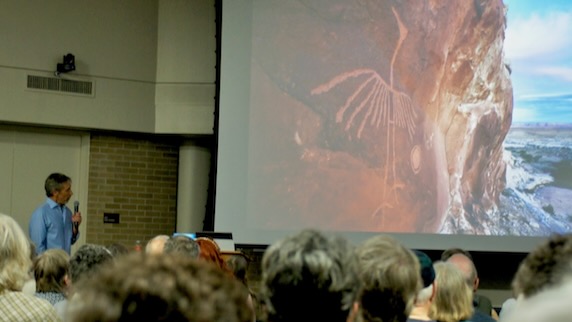
They weren’t flying amongst the cranes but they mimicked the way the whooping cranes traveled.
“We didn’t know how far we were going to fly, where we were going to eat, where we were going to sleep,” said Forsberg.
The trip was uplifting as well as disturbing.
“I saw the wonder and the worry,” he said. “I took 30,000 pictures and 98 percent of those photos had ‘us’ in them,” referring to development, agriculture, tar sands mining.
He also spent eight days lying prone in a camouflaged blind in the Canadian wilderness photographing their nesting grounds.
At the festival talk, he lamented that despite their protected status, they’re still poached by humans.
In 2023, four hunters in Oklahoma were charged with shooting and killing four whooping cranes.
Also troubling, last year, the first known whooping crane death of Avian flu was documented.
“These birds are in our world," said Forsberg. "We get to decide if they survive in spite of us or because of us.”
Read more articles from the trip:
GREEN SOURCE TEXAS FLOCKS TO WHOOPING CRANE FEST. Green Source Texas and friends headed south last month to check out the 2026 Whooping Crane Festival in Port Aransas.
TEXAS MARINE SCIENCE INSTITUTE IS TOP CENTER FOR RESEARCH, EDUCATION AND WILDLIFE REHAB, The University of Texas Marine Science Institute in Port Aransas is the oldest and most significant marine research facility on the Texas coast.