
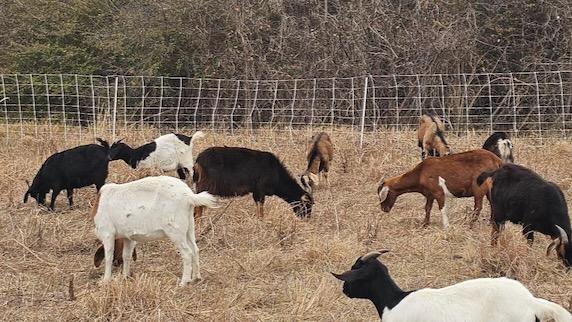
The city of Dallas brought in about 300 goats during February to help control privet at White Rock Lake. Photo by Chris Morris.
Visitors to White Rock Lake may have done a double take recently after a herd of goats was enlisted to take care of a thorny problem.
Earlier in February, the city of Dallas brought in about 300 goats from a Mineral Wells ranch to clear away privet, a highly invasive shrub that overruns many North Texas natural areas.
PRIVET PROBLEM
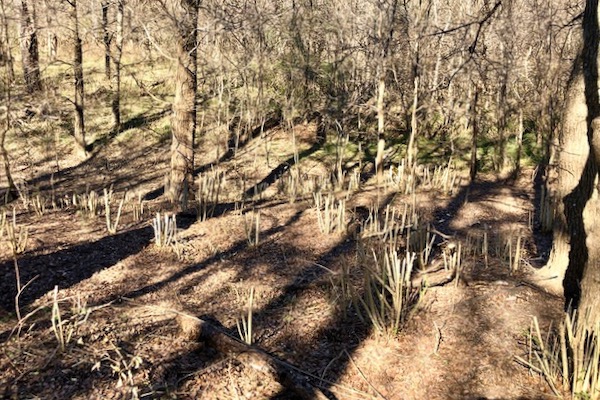
In North Texas, invasive plants pose a huge threat to ecosystems. Ask any local nature center manager which plant species plagues them them the most — chances are privet will be at the top of the list.
Privet is an extremely hardy drought tolerant bush, common in North Texas. Unfortunately, the nonnative species is a popular landscaping shrub, which many homeowners continue to plant in their yards, unaware of its destructive effect.
Brett Johnson, conservation manager and biologist at Dallas Parks and Recreation, emphasized the danger of invasive species like privet.
“A lot of [invasive species] will take over an area, whether it’s out in the prairie, or maybe it’s in the forest understory. They will create a monoculture.”
And with that monoculture comes a decrease in diversity of native plants.
“As you see the diversity of plants start to decline, you will start seeing any of the insects that are associated with those plant species decline.”
GOAT POWER
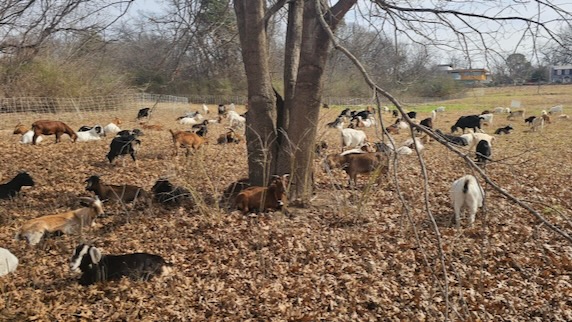
While the city of Dallas uses a variety of methods to combat the aggressive little hedge, over the past few years, goats have been recruited in the battle.
Johnson said that the goats at White Rock Lake are not a replacement for mowing but are part of a multi-pronged effort to combat privet.
The goats are brought in to trim down areas overrun with invasive plants so that other crews and volunteers can return and finish the job.
The clearing done by the goats not only increases visibility in specific areas but also addresses fire risks, he said.
The goat’s efforts makes it a lot easier for machines, like mowers and forestry mulchers and crews to navigate areas with invasive species.
“When you’re running a machine, you can’t see where you’re going,” Johnson said.
While the goats provide a unique service when managing privet, Johnson emphasized that they have their limitations.
“When it comes to the goats and privet, yes, they will eat it, but it's not the end-all be-all of management.”
For example, goats can only reach up to five feet. So while they will eat vines, leaves and anything below five feet, the parts of invasive species above five feet remain.
However, the goats pave the way for follow up treatments by volunteers, which is something Johnson mentioned that is being explored.
“We are looking at hopefully maybe in the next month or so, kinda having a privet party out there, and getting volunteers to come out and help us cut the privet.”
OTHER GOAT PROJECTS
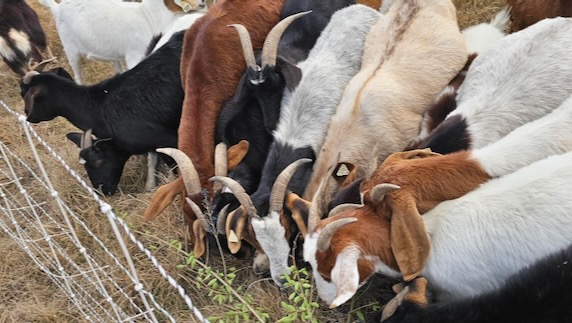
This is not Dallas Park and Recreation’s first rodeo using goats. Goats were introduced in 2023, by Dallas Water Utilities in a small pilot project by Fraser Dam. They were also used with partner organizations again in April 2025 at the Bachman Green Belt.
“We worked with the partners since then. We helped the DWU along the AT&T trail,” Johnson said.
For that project, 1,000 goats were brought in to thin out the area and create a shaded fire break. In addition, goats were used to clear Creekside Park and along Trinity Forest Spine Trail.
Goats were also used by the Friends of North Haven Trail and Friends of the Valley at Valley View Park. The goats were used to not only combat the privet, but cut down on nefarious activity due to overgrowth.
“We wanted to increase the visibility of that area,” Johnson said.
WHITE ROCK WORK DAYS
Three weeks ago, when the goats first came to White Rock Lake, they were working around the Bath House Cultural Center area.
“They’ve been handling about three quarters of an acre a day,” Johnson said.
The goats have been munching away at privet in a nearby prairie area as well, where their job has not only been to eat the invasive species and create visibility, but also improve the nutrient cycle with their manure. They’re also breaking up batch layers of grass formed as a result of mowing. With the goats grazing and moving their hooves, it makes the prairie area more manageable for future privet treatment.
“As they’re digging around, between their nose and their hooves, walking around, they’re busting up that batch,” said Johnson. “It’s our first time really running [the goats] on the prairie area, so we’re having to see how it works out. Hopefully we may be able to skip a mowing cycle there.”
VISIBILITY
Goats can and have been used to tackle other invasive species as well, however, Johnson stressed the temporary nature of goats, explaining that they aren't a permanent solution to tackling invasive species.
“One of the things I want everyone to understand is that the goats are just one tool in the tool box.”
He admitted that goats are not the perfect tool.
However, the presence of the goats at White Rock and other places in Dallas, have made a positive impact on the fight against invasive species and visibility in specific areas.
“[Goats are] the nice cute and fluffy tool that’s out there.”
HOW TO SEE THE GOATS
The goats will be at White Rock Lake through Sunday, March 1. Johnson said that on Saturday, Feb. 28, from 9 a.m. to 11 a.m. they will be hosting a Privet Removal Party at the Bath House Cultural Center as a follow up treatment.