
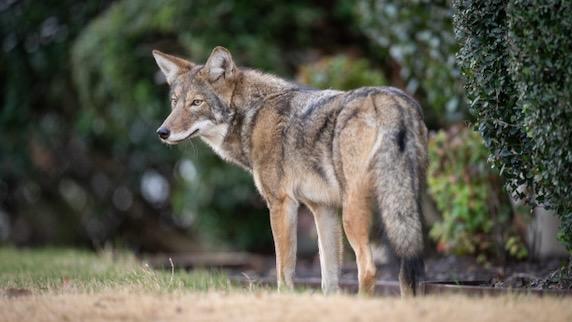
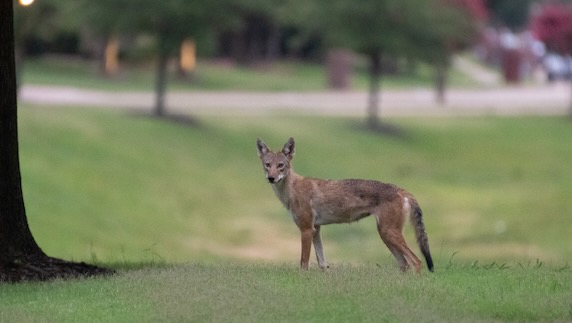
A handsome coyote seen at Twin Creeks Park in Allen, Texas. Photo by Karin Saucedo.
Have you been seeing coyotes (Canis latrans) in your neighborhood during the day? Here’s why.
Coyote breeding peaks around Valentine’s Day, going from January to March. Two months later, about a half-dozen pups are born and growing rapidly. They’re dependent on mom for about six weeks, first milk, and then around three weeks of age begin on solid food
Starting mid-April into summer, coyote parents have a lot of hungry mouths to feed. They range further from the den, usually located in natural areas and wide riparian corridors, and hunt during the day in addition to their usual nocturnal patrols. This can lead to conflict with humans and pets.
By three months of age, which is mid-July or five months after conception, they start hunting and scavenging with their family group and return to nocturnal hours. So from April until then is a time of extra caution. Keep your cats inside (which is a good idea anyway), and be vigilant with your small dogs and children: never leave them unattended in the yard, and keep them within a few feet of you when outside at the park — especially at dawn and dusk.
HAZING 101
When coyote alarm messages started appearing on my neighborhood social media, I searched straight away for my little old cat who we let out for daily naps in the front yard. She was inside, ensconced in her usual nap place. But it's quite understandable how a daytime coyote can evoke a panicked feeling.
The next day, while gardening in my front yard, I heard dogs barking. Two coyotes were trotting up the hill through front yards. I immediately began hazing protocol, yelling “Get out! Get out of here! Go, go!” and made firm eye contact with the one who turned around to look.
I started toward them while keeping a significant distance, continuing to yell while waving my arms, clapping, and slapping my thighs. Had a short stick or small rock been handy, I’d have thrown it in their direction. A young woman driving by stopped and joined me as the duo found a narrow opening between two yards to escape.
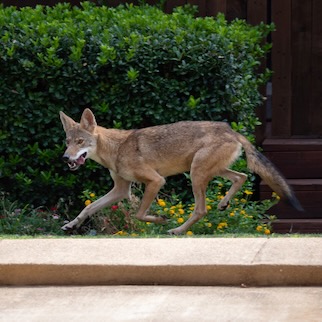
Message sent: This is not a good place to be hunting.
Had I come from indoors, I would’ve grabbed some noisemakers that I keep handy:
• Air horn
• Rock shaker
• Tambourine
• Loud whistle
• Clanging bells
• Pot and pan lids
If they’re handy, turn on your sprinklers or use the power-spray setting on your hose nozzle.
An optimal noisemaker is to partly fill a hard plastic bottle, like the kind laundry detergent comes in, with some medium-sized, rough rocks and cap it. Shake it vigorously while yelling in territorial squalling so terrifyingly that the coyote and the whole block will think you’re rabies-level mad.
Your entire demeanor needs to bristle with super intensity:
“This is my territory, this is my family!! I will defend it to the death!!!”
When the coyote turns around to check on you, throw the jug in its direction. Extra points if it bounces off pavement. Super loud!
Yes, it takes all that. It’s not sufficient for them to simply run off. They need to be very wary about returning.
If you’re in a wildlife-rich area like I am near White Rock Lake, with lots of large trees and creeks, be prepared by keeping these handy. My house is only three blocks from a greenbelt that feeds into the east side of the lake.
Hazing greatly reduces coyote-human conflict. Urban coyotes see humans frequently and become acculturated to us, while usually remaining unseen. Their innate fear of humans must be reinforced through hazing. They need to feel uncomfortable in our yards, making wild areas seem safer.
It seems like such a rude thing to do, especially by wildlife lovers. But hazing is ultimately a compassionate act. Encouraging coyotes to stay out of residential areas during the day reduces their conflict with humans and decreases the likelihood that humans will take actions that may result in the coyote’s demise.
PROTECTING YOUR PETS
The Number One thing not to do if you encounter coyotes is to let your dog chase them. That creates territorial issues that coyotes might be compelled to defend, leading to injury to your dog and prompting coyotes to patrol the area more often.
Most of the time, an attacked coyote nips a dog's flanks and sides to buy time for escape. But an aggressive dog could provoke the coyotes to go on the offensive and inflict more severe injuries.
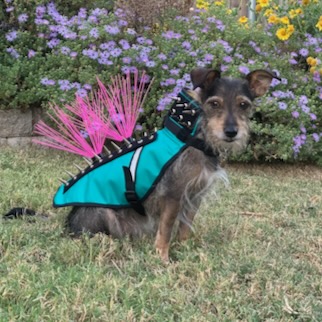
Unleashed dogs in parks are a recipe for coyote conflict, and small ones are easily mistaken for prey. Petite dogs can wear spike coats or body armor, but they can be uncomfortable, and Fluffy may not want to look like the Sex Pistols. However, if you live in a coyote- or bobcat-populated area, they can help your pet explore the backyard while unattended.
An indoor cat is a safe cat. The cause of most cat deaths is cars. Often, coyotes seen carrying a deceased cat have scavenged it off the street. Trapped and euthanized coyotes rarely have cat or dog flesh in their stomach contents.
To keep an indoor cat entertained, consider a catio. These roofed and screened enclosures have bridges, tunnels and other features to facilitate fun movement, as well as ledges and platforms for bird and squirrel watching and sleeping. If you insist on free-roaming cats, erect seven-foot-tall wooden cat poles in the yard that allow cats to escape if they’re awake and can reach them in time.
PARK PROTOCOL
If you and your pet encounter a coyote in a park or wild area, please do not haze unless the animal is approaching you. After all, in natural areas you are in their territory, plus hazing might push them toward other humans. Simply move away from the coyote and advise others who might encounter it. Avoidance is always best.
If you notice a coyote following you without assuming a stalking posture, it may be a behavior called escorting, which can indicate the presence of dens or young pups. The coyote is monitoring you while you’re in its territory and encouraging you to leave promptly without being aggressive.
Graphic: escorting coyote-Project Coyote. Educational graphic from Project Coyote.
More tips:
• Running away from a coyote can stimulate prey instincts and encourage it to chase.
• Keep pets in parks on a leash. It’s almost always a municipal law. A leash six feet or shorter is best.
• Never corner a coyote. Leave an avenue for it to escape.
For coyote sightings in parks and natural areas, report them on iNaturalist using their app, and include a photo if possible. This helps wildlife biologists and officers understand coyote movement and patterns.
COYOTES ARE PART OF URBAN LIFE
Despite centuries of attempts to control and even exterminate coyotes, they remain. They’ve even expanded their range, mastering the urban environment. Coyotes in cities tend to be larger and healthier than those in rural areas. Learning to coexist with coyotes is the only way.
Coyotes serve as vital rodent control in urban areas. Rodents, as well as rabbits, are a mainstay of their diet. But their visible presence, especially during the day, can raise concerns for the safety of small children and pets.
When you see a coyote in a residential or commercial area, call the Dallas Coyote Hotline: 469-676-9813. If there are reports of the rare, aggressive coyote, animal control will endeavor to remove it.
But any trapping can backfire. Coyotes organize into packs led by a breeding male or female, which generally mate for life. Removing one or both can cause a rebound effect.
According to coyote advocate Karin Saucedo, trapping “disrupts the pack and allows the younger breeding age females to go into ovulation when they usually wouldn’t, so outsider coyotes can breed with them. It’s basically babies raising babies. They don’t have the experience that seasoned breeding males and females have in teaching their offspring urban survival skills.”
Coyotes will breed to the level that the environment can sustain. Trap enough coyotes to lower population levels, and the remaining coyotes will vigorously breed to replace that population. Any trapped wildlife simply sends up a vacancy sign encouraging others from neighboring areas to move in.
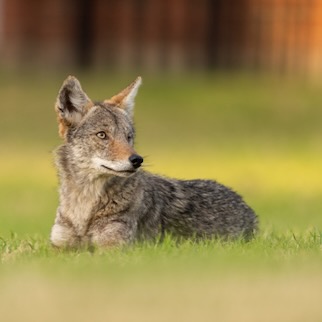
Photo: resting coyotes in coppell_KarinSaucedo. Coyote at rest by Karin Saucedo of Song Dog Watch.
Coyote Resources
RECOMMENDED VIDEOS
For those who’d rather watch a video than read, here are two excellent tutorial videos, with the 20-minute one being well worth the time. More resources at the article’s end.
• Urban Coyotes from Texas Parks and Wildlife Department featuring Sam Kieschnick, TPWD urban biologist for eastern DFW. The focus of the 2.5 minute video is hazing coyotes.
• Coyote as Neighbors, a 20-minute primer from CoyoteCoexistence.com based in Atlanta. The focus is on how coyote conflicts occur, interpreting coyote vocalizations, and hazing, with an emphasis on getting them away from your dog or cat. View video here.
• Coyote Coexistence: Living in Harmony with America’s Song Dog. A local and very thorough spin on the topic, preparing wildlife fans to become more effective advocates and educators. Video of talk and Q&A for Arlington Conservation Council by Karin and Roberto Saucedo of Song Dog. View video here.
The city of Dallas coyote information page includes: Coyote Tracking Map, Dallas Animal Services Coyote Management Plan, Living With Coyotes PDF, Living With Coyotes PDF in Spanish, Coyote Yard Audit Checklist, Coyote Hazing Guide, and Coyote Deterrents and Repellants.
The nonprofit’s coyote page includes: downloadable flier, plus tips on discouraging coyotes from your property and when to be concerned. Also call the DFW Wildlife Hotline at (972) 234-9453. Donations encouraged.
Project Coyote assists residents and local advocates in living with coyotes through humane, science-based solutions by providing the guidance and tools they need. Information includes Model Coyote Coexistence Plan, Guide for Community Advocates, downloadable educational materials and educational videos on attractant reduction, hazing and pet safety. The Coexisting with Coyotes Door Hanger is superb.
Watch the 2026 webinar 2026: Wild Kinship: A Look Into Coyote Lives Through Two Lenses from Project Coyote with wildlife photographers Karin Saucedo and Mark Surls.
The mission of Song Dog Watch, formed by Karin and Robert Saucedo, is to foster compassion and coyote coexistence in North Texas by educating communities about coyote behavior and protecting them from persecution. Support their work with donations. Follow their Facebook and Instagram pages.
Watch Living in Harmony with America’s Song Dog, a video of talk for Arlington Conservation Council by Karin and Roberto Saucedo of Song Dog Watch.
TEXAS PARKS AND WILDLIFE DEPARTMENT
TPWD’s Urban Coyote page offers tips for reducing human-coyote encounters.
Read the Green Source Texas article Coyotes rattle some North Texans, but experts say we can coexist by Arlington-based reporter and naturalist Michael Smith.