
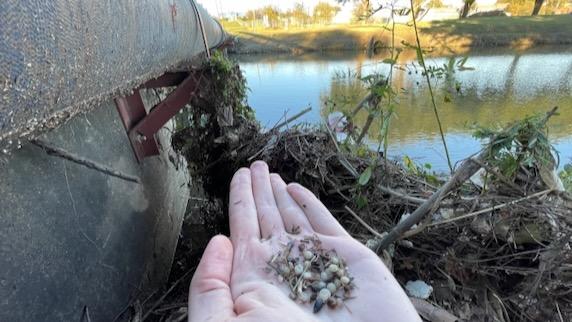
Plastic pellets called nurdles were found at Mountain Creek Lake in Grand Prairie by a volunteer. Photo by Environment Texas.
On the shores of Mountain Creek Lake in southwest Dallas, the pollution is easy to miss. The pellets are often smaller than a pencil eraser and they blend into the gravel and sand along the waterline. But they are there, tiny plastic beads by the thousands, and they are not going away.
These pellets — known in scientific circles as "pre-production plastic pellets" and more colloquially as “nurdles” — are the raw material from which virtually every plastic product is made: water bottles, grocery bags, food containers. Factories melt them down and mold them into shape. But billions of nurdles never make it to the factory. They spill at loading docks, blow off trucks, wash out of rail cars and drift from manufacturing sites into streams, rivers, lakes, and eventually the ocean.
On March 5, 2026, a Union Pacific train derailed near Weatherford, spilling thousands of plastic pellets across the tracks and surrounding ground. When Ian Seamans, city hall advocate for Environment Texas, visited the site nearly three weeks later, the pellets were still there — uncovered, uncontained and at risk of blowing into the surrounding environment.
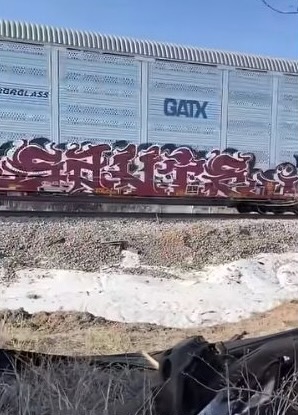
"We visited the site of the train derailment in Weatherford again on March 24 and unfortunately found that pre-production plastic pellets were still uncovered and escaping into the environment," Seamans said.
This Saturday, May 2, Seamans and thousands of volunteers across the country — and the world — will get out to their local waterways to look for pellets just like those. The second annual International Plastic Pellet Count is a citizen science effort that invites anyone, anywhere, to spend at least 10 minutes searching a riverbank, lakeshore or beach for nurdles, then submit their findings online. The data goes into a global map that researchers, regulators, and advocates use to document the scale of a pollution problem that, for most people, has long been invisible.
DANGER TO WILDLIFE
Nurdles can look remarkably like fish eggs, so wildlife treat them as such. Birds, fish and sea turtles eat nurdles, filling their stomachs with indigestible plastic. The pellets also absorb and concentrate toxic chemicals from the water around them, including DDT, PCBs and mercury, turning a small piece of plastic into a concentrated toxin package that can move up the food chain.
Once in the environment, nurdles are essentially a forever problem. They are too small to filter out of waterways, too light to sink and stay put, and too numerous to collect by hand at scale. And as they break down over decades into even smaller fragments — microplastics — they become even harder to track and remove.
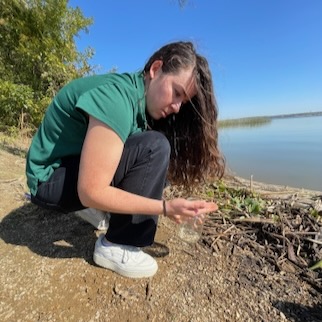
"More than 10 trillion plastic pellets escape into our environment every year," Seamans said, "and once in the environment they are almost impossible to remove."
Activist and fourth-generation shrimper Diane Wilson, who has spent decades fighting plastic pollution along the Texas Gulf Coast, says the harm compounds across the entire ecosystem.
“It goes to the fish. And it goes to the birds. And it ends up in our own bodies,” she said.
Scientists have already found microplastics in oyster tissue in the bays near her home.
“You have oystermen going out and bringing in oysters for people to eat and they’re finding that in the tissue of the oysters.”
A TEXAS-SIZED PROBLEM
Texas is at the center of the nurdle crisis in America, and not only because of its Gulf Coast petrochemical corridor. The state is home to at least 35 facilities identified by EPA data as producing pre-production microplastics, most of them concentrated near Corpus Christi, Seadrift, Point Comfort and Freeport.
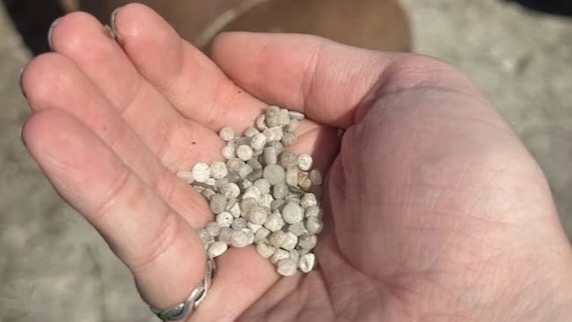
According to data compiled by Nurdle Patrol — a citizen science network founded in 2018 at Texas A&M-Corpus Christi — all 20 of the highest standardized nurdle counts in the Gulf of Mexico have been recorded at Texas sites. Volunteers have collected more than 2.4 million pellets along Gulf beaches since the organization was founded, with one beach estimated to have approximately one million nurdles per kilometer of shoreline.
But the problem is not confined to the coast. The Weatherford derailment was a stark reminder that nurdles travel wherever plastic does — which is everywhere. Rail lines, highways and distribution centers across inland Texas are all potential spill points. Environment Texas has documented evidence of chronic pellet spills reaching Mountain Creek Lake in Dallas, bringing the pollution problem directly to the doorstep of one of the state's largest metro areas.
The regulatory framework meant to address these spills has proven woefully inadequate. When Seamans contacted the Texas Commission on Environmental Quality about the Weatherford spill, the agency told him its rules only require reporting when a spill involves more than 100 pounds of industrial solid waste entering a state-owned waterway. Because the Weatherford pellets did not directly reach a named waterway, Union Pacific was not even required to submit a final cleanup report to TCEQ.
"Texas needs to do more to both stop these spills and ensure that when they do happen, they are covered and cleaned up promptly," Seamans said.
The regulatory gap is not new. TCEQ proposed rules to govern plastic pellet discharges in 2022, but backed off after industry opposition. Meanwhile, the situation along the Gulf Coast has grown more contentious. In December 2025, a citizens' group filed a Clean Water Act notice of intent to sue Dow Chemical over discharges from its Seadrift facility. The State of Texas filed its own lawsuit against Dow in February 2026. In March 2026, Dow responded by asking Texas regulators to legalize plastic pellet discharges from the plant — a move Seamans called deeply troubling.
WHY IT MATTERS BEYOND THE BEACH
The economic consequences of nurdle pollution extend well beyond environmental harm. Texas's Gulf Coast is home to a multibillion-dollar fishing and tourism industry. Shrimpers, oystermen and recreational fishers depend on clean waterways. In 2019, Wilson secured a landmark $50 million legal settlement against Formosa Plastics for illegal nurdle discharges near Point Comfort — the largest citizen suit settlement in the history of the Clean Water Act. The case galvanized a broad coalition around the issue that now includes tourism industry representatives, a former oil executive, and the co-founder of Airbnb, who have all backed legislation to tighten pellet regulations in Texas.
Wilson says most people have no idea how much plastic is escaping from facilities near the water.
“They have no idea about these plastic plants that are around us and how much that is flowing out into the water,” she said.
She also stressed that the problem is not limited to pellets alone. “It’s not just pellets that are being produced, there’s also powder,” she added. “You have the polyethylene, polypropylene, and it’s floating all over the water.”
In the most recent legislative session, state Rep. Erin Zwiener filed House Bill 4028, which would classify plastic pellets as industrial waste subject to regulation and cleanup requirements. But that bill and a companion bill filed in the Senate by Sen. Judith Zaffirini both failed to advance out of committee.
Wilson points to the staggering cost of cleanup as evidence that stronger regulations are long overdue. She described one cleanup of stormwater outfalls from a single plant that took nearly four years, required excavation three feet deep, used roughly 4,000 truckloads to haul plastic debris to a landfill, and cost more than $50 million.
“And who’s going to be liable for that?” she asked.
FROM A BEACH CLEANUP TO A GLOBAL NETWORK
The International Plastic Pellet Count traces its roots to 2018, when a massive nurdle spill near Corpus Christi prompted local scientists and volunteers to start systematically surveying Texas beaches. That effort evolved into Nurdle Patrol, a citizen science platform hosted by the Harte Research Institute at Texas A&M-Corpus Christi, which now operates as an international monitoring network.
The first International Plastic Pellet Count was held in May 2025, organized by U.S. PIRG Education Fund, Environment America, 5 Gyres, Waterkeeper Alliance, Nurdle Patrol, and allied groups. More than 1,100 volunteers turned out at over 200 sites across 14 countries and 29 U.S. states, collecting nearly 50,000 pellets. The data from that single day provided a clearer global picture of pellet distribution than researchers had previously been able to compile.
JOIN THE COUNT IN TEXAS ON MAY 2
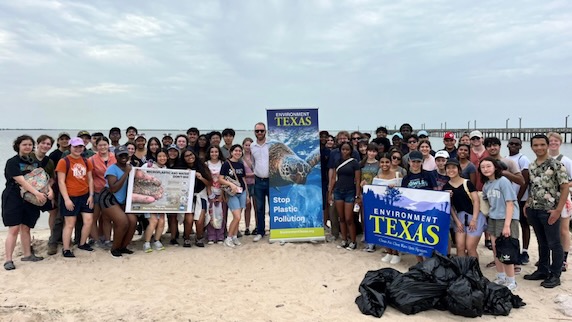
This year's count is expected to be significantly larger, with organizers hoping to reach all 50 states. In Texas, Environment Texas plans events in multiple cities, including in the Dallas area. Participants do not need any special equipment or expertise — just a willingness to spend 10 minutes at a local waterway looking for small plastic beads.
The protocol is straightforward: visit a riverbank, lakeshore or beach, search an area for at least 10 minutes, count any plastic pellets found and submit the results through Nurdle Patrol's website < https://nurdlepatrol.org/home>. Even a count of zero is valuable data — it tells researchers where pellets are not present, helping to map the boundaries of the problem.
The second annual International Plastic Pellet Count will be held on Saturday, May 2. Volunteers are encouraged to look for pellets at their local waterways and document their findings.
Seamans encouraged readers to sign up and participate.
"Take action by signing our petition and signing up to participate in the International Plastic Pellet Count on May 2nd," he said.
Upcoming Texas event locations are being finalized and will be listed at environmenttexas.org as they are confirmed.
CITIZEN SCIENCE IS MOVING THE NEEDLE
The data generated by citizen scientists like those who will participate on May 2 is not simply symbolic. It is being used in regulatory proceedings, legislative hearings and lawsuits. The Nurdle Patrol database provided critical evidence in the Formosa Plastics case and has been cited in legislative testimony in Austin. When Dow asked Texas regulators to legalize its pellet discharges, advocates pointed directly to citizen-collected data showing the ongoing harm those discharges cause.
Industry self-regulation has not filled the gap. Operation Clean Sweep, a voluntary program launched in 1991 that asks plastics manufacturers and handlers to adopt better containment practices, has been widely criticized as unenforceable and insufficient. The program has no independent auditing, no penalties for non-compliance and no mechanism for public reporting. Seamans described it as having limited effectiveness due to the lack of accountability.
That is precisely why the annual count matters. The more data points in the map — from Gulf beaches to Dallas lakeshores to Weatherford roadsides — the harder it becomes to dismiss the problem as isolated or manageable.
"Since they start small," Seamans noted, "once in our waterways they can more easily degrade into even smaller microplastics" that are far more difficult to study, regulate or remove.
To find a counting event near you or to register your own count, visit nurdlepatrol.org or environmenttexas.org. Texas event locations will be posted as they are confirmed. The count officially begins May 2, though data collected throughout the month of May counts toward the final tally.