
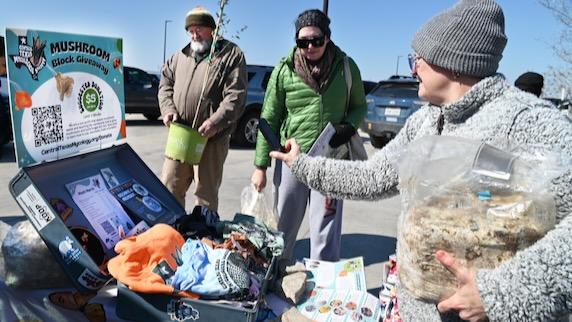
The Central Texas Mycology Society held a mushroom block giveaway in Manor, Texas at the end of January. Photo by Barbara Kessler.
The magic of culinary mushrooms and their antioxidant and nutritional qualities has been a growing presence in cooking and wellness circles. You’ve heard about how mushrooms provide B and D vitamins, tamp down inflammation, boost brain acuity and may even reduce cancer risk.
In Central Texas, a robust network of volunteers and fungi experts are touting and teaching about those benefits and taking mushroom mania even further.
They are getting free mushrooms into the hands of hobbyists, gardeners and home cooks by collecting and recycling mushroom blocks discarded by small commercial growers of gourmet mushrooms. With the right care, these blocks grow a second “flush” or more of mushrooms, producing the same gourmet varieties that the block was inoculated for, such as Oyster, Black Pearl, Lion’s Mane, King Trumpet and others.
BLOCK PARTY
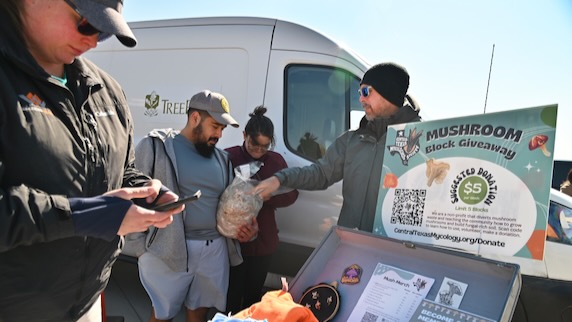
The nonprofit group, Central Texas Mycology Society, also promotes a secondary use of the blocks, once they’re completely spent, by showing people how to incorporate this mycelium-rich, woody growing material into gardens and landscapes.
“Our volunteer network from Central Texas Mycology picks them (the blocks) up from the farms. We are diverting them from the waste stream at that point, and they go on to neighborhood locations where you can pick them up. You can find that online, but also at events like this,” explained Scott Blackburn, an organic gardening educator and CTMS volunteer whom we met at a mushroom block giveaway in Manor, Texas, at the end of January. Blackburn had brought some 50 blocks to hand out at the event, held in conjunction with Tree Folks, which was giving away tree saplings.
The day was cold. A bitter wind whisked across the H-E-B parking lot, and the Austin-area crowd was bundled up like you don’t usually see in hats, mittens and down jackets. But free is free and at least 100 people stood firmly in line to get their free trees at the opening noon hour. These tree-growing aspirants and random H-E-B shoppers then migrated over to Blackburn’s mycology exhibit and packed around his display like a cluster of Pioppini mushrooms. (Pioppinis shoot forth like spindles from a common stem and are prized in Italian and Asian cuisine.)
Once people understood that these bucket-sized bags of creamy/brownish material would, with minor management, produce a free culinary treat, they were copying QR codes, balancing their Tree Folks saplings on a hip and loading up mushroom blocks. They peppered Blackburn with questions as they dug out the $5 per block suggested donation, which helps support CTMS.
A mushroom block that has produced once for the commercial grower could go on to grow “potentially four more rounds of mushrooms,” Blackburn said, though his assessment might be optimistic. Others say mushroom block recyclers will get maybe two or three new flushes.
Blackburn, an avid garden adviser on YouTube, does know mushrooms, though. He tends about 50 blocks at his home at any given time, constantly harvesting a variety of fungi that he sautés and bakes. Then he pummels the blocks into their second iteration as soil builders for vegetable beds.
“That’s why I’m here. That’s why I volunteer with the organization. I use them in my garden. I grow mushrooms on my front porch, and I feel good about it,” Blackburn said. “I really love harvesting them. When they start to grow, the little pins, you get excited and in about three to five days you’ve got something you can break off and cook with. To break them off, you kind of peel them off. It’s a really interesting experience.”
SHROOM LOVERS
Central Texas Mycology Society has been bringing these interesting experiences to a wider audience since its formation in 2014. Members teach classes on growing and foraging for mushrooms and understanding and appreciating fungi.
“Our primary goal is education. Secondarily, we want to support the mycology community,” said Angel Schatz, executive director of CTMS. “We want people to realize that we would not be here unless fungi did all the work helping us become a networked planet.”
These are worthy goals. But even Schatz, a reverent fungi aficionado who refers to mycelium – fungi that connect life underground — as “the earth’s internet,” says she has been surprised by how the group has, well, mushroomed in recent years. It’s grown from 25 members in the early days to more than 600, with a majority of members active in the mushroom block rescue program.
Several factors make Central Texas a prime spot for this unique sustainability endeavor: There are many successful small gourmet mushroom growers in the region and also a robust community of urban gardeners with a DIY mindset.
The small growers are key because they are focused on gourmet mushrooms, which use wood- or sawdust-based growing substrates for their growing blocks. These are reusable as compost in vegetable gardens, unlike the discarded mushroom blocks from big commercial enterprises that grow varieties most popular in groceries — cremini, button and Portobello mushrooms — in a growing mix that contains salts, rendering these blocks unusable for vegetable garden compost.
While many of the Central Texas gourmet growers are relatively small businesses, such as Hi-Fi Mycology, Fallen Oak Mycology, Cap City Shrooms in Austin and Small Hold in Buda, they still produce a large amount of organic matter. Picture mushrooms growing from dozens of blocks, each the size of a small microwave, placed on rows and rows of shelving in climate-controlled settings. The mushrooms pop and grow in a matter of days and weeks. Then the growers send out the used blocks and start with fresh blocks.
“These mushrooms produce three times the amount of waste that other vegetables do,” Schatz said.
She estimates the Central Texas network of growers in CTMS’s recycling circle produces some 7,000 to 10,000 spent mushroom blocks each week. As more people incorporated mushrooms into their curries, salads, tea and gardens, fueling this mushroom boom, it became clear that a recycling solution was needed.
“These mushrooms produce three times the amount of waste that other vegetables do,” Schatz said.
With the support of the growers and its burgeoning network of mycology appreciators, the Central Texas Mycology Society stepped in, designed and grew its block recycling program.
Each recycled block came with the enticement of free food: If the recipient managed the second or third fruiting or flush, they’d get a culinary treat worth $20 or more at the grocery. That was one motivation. Schatz said another came from Mother Nature. The deadly and confining twin disasters of 2020-2021, the Austin “Snowpocalypse” and COVID, left people searching for self-sufficiency and community connections. That propelled CTMS’s efforts to build out donation sites and motivated volunteers to donate their time picking up and distributing the blocks.
“People were cooped up and needing something to do. Everyone was really interested in growing mushrooms,” she said.
Today, the blocks are regularly distributed to sites at people’s homes, farms, nurseries, community gardens, farmer’s markets and nature-oriented events, like Tree Folks’ recurring giveaways. The sites change some with events and seasons, but you can find a current collection site near you at the CTMS website.
Schatz says the mushroom block recycling program diverts nearly 800,000 pounds of organic waste from landfills, which is akin to planting more than 7,000 trees.
The recurring drought years afflicting Central Texas also has whet appetites for the mushroom blocks as compost for trees.
“It’s been very dry over the last couple of years,” Schatz said, so the CTMS has devoted significant programming to explaining how to deploy mushroom blocks into the landscape and boost the drought-resilience of trees. The city of Austin, which wants to expand its heat-mitigating tree canopy, has supported CTMS with a grant to research and teach how decomposer fungi and mycorrhizal fungi help trees by building soils that retain moisture.
Schatz says the mushroom block recycling program diverts nearly 800,000 pounds of organic waste from landfills, which is akin to planting more than 7,000 trees.
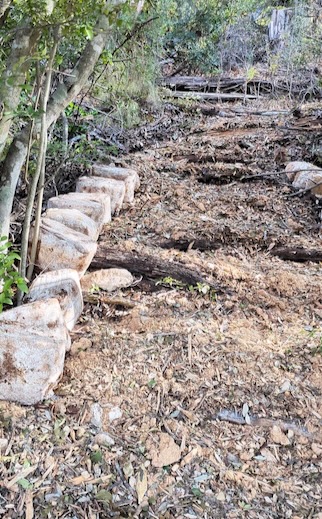
Kevin Leahy, a retired attorney who lives on a treed 2.5-acre plot in West Lake Hills, is bearing witness to the virtues of adding mycelium to the soil. For years, Leahy has been nurturing trees and natives with various techniques on his hillside property, which dips toward a ravine. Adding the spongy mushroom blocks to his trails and trees over the last two years has made a significant impact.
“Enriching my soil was the number one goal. Reducing erosion was my number two goal,” Leahy said. “I’ve been doing that for 25 years and have had success there … But the mushroom blocks are taking it to another level.”
An active volunteer for the CTMS mushroom block program, Leahy helps distribute the blocks (Schatz calls him a “superstar” volunteer who logged 71 pickups last year) and brings batches of them home. He sees the blocks he’s embedded along slopes stemming erosion and those at the base of trees holding moisture. The blocks also make great borders for terraces, he says. But lately he’s most excited about blending broken-up, palm-sized pieces of the blocks with leaves and other organic material creating a multi-use compost. “It breaks down and provides a lot of love to the land a lot quicker,” he said.
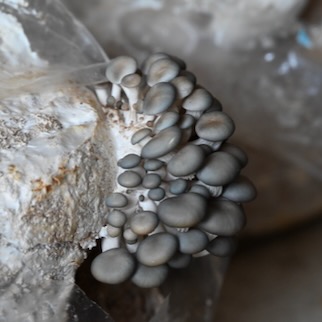
Some people worry that placing the mushroom blocks or mushroom compost made from the blocks is introducing a new element to the landscape, but it’s really just boosting the mycelium that’s already in the soil, Schatz says. work to break down woody material so plants can use it.
“Mushroom blocks accelerate the decomposition process and add structure to the soil,” she says. “It rebuilds the forest.”
The miraculous takes place underground and unseen – Schatz’s “internet of the earth” at work – with the fungi acting as connective tissue, binding the soil and accelerating the work of the microbiology already present. The fungi and the bacteria and the nematodes etc., all work together, a web of life, delivering nutrients to the trees and hardening them against drought. The process is more complex than just creating soil that can hold water, though that’s part of it, and it doesn’t hurt that at the start, the spongy mushroom blocks also can hold moisture.
Leahy says he’s inspired to be part of this life-sustaining restoration effort that nurtures the notoriously thin Hill Country soil. But like others who’ve become students and advocates of mycology, he’s also tickled by his taste buds, becoming a casual mushroom gourmand, cooking up or gifting the mushrooms that pop up all over his landscape. He estimates he’s harvested 30 or 40 pounds of mushrooms like Pioppino and Blue Oyster. The food is a bonus, growing freely within his landscapes.
Which brings us back to the giveaway on that bright and brisk late January Saturday. (Truly, y’all 45 is legit cold in greater Austin.)
In less than an hour, people had claimed all of the mushroom blocks on offer, scooped up flyers and checked out coming events by the Mycology Society.
Blackburn, a veteran of these giveaways, was not surprised.
“It’s really a win, win, win situation,” he said. “You get to rescue these blocks, keep them out of the waste stream, reduce greenhouse gases potentially. You can grow your own food. Healthy food, medicinal food, and you can build soil so that your trees will be more drought-tolerant and adapted to your landscape.”
RESOURCES
In the DFW area, Texas Fungus in Arlington sets out mushroom blocks daily, which the public can pick up. First come, first serve. Call ahead to see if blocks are available. 3201 E. Pioneer Parkway, Suite 9, Arlington. 682-410-0101.
Mushroom Growing and Composting Tips CTMS
Community Mycology Grown on Mushroom Compost
Get Fungi In Your Garden with Mushroom Blocks (Scott Blackburn)