
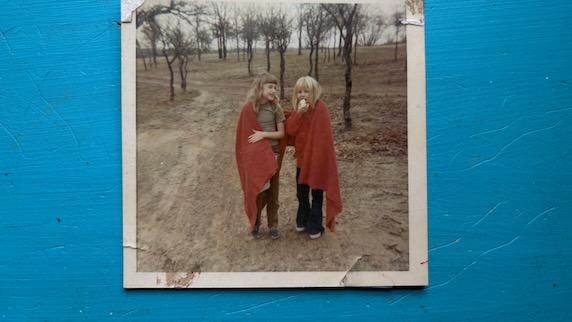
Author (right) with friend on undeveloped city land that would become Veteran's Park in Arlington. Circa 1970. Family photo.
Michael Smith recently reflected on his youth as a “nature kid,” exploring the natural world in a way that informed his future avocation as a naturalist and nature author.
Being a fellow Baby Boomer, I too spent my youth immersed in nature. But I had no scientific bent.
I did not have a knack for learning species names or observing anatomical parts.
I just had that creature love of the outdoors that any creature — human or animal — can have.
Because of the time and place and family I grew up in, I was allowed to develop it.
In our suburban North Texas neighborhood, through the 1960s and 70s, kids were encouraged and expected to play outside until dark. Especially in summers, we were tasked with getting fresh air and sunshine, working off excess energy and staying out of the way.
Happy to do it! It was a paradise outside.
TALKING TREES AND BURYING THE DEAD
And we were not alone. To me, everything in the natural world was alive.
My favorite perch was high in the big sycamore tree in our backyard. I could straddle a branch and look down at the patio far below. I felt safe as I dangled my legs and leaned back on the trunk. I imagined what it would like to live up there, like in Swiss Family Robinson. I admired the tree’s smooth white bark and the sound of its leaves in the breeze. This tree was special in my book — a friendly soul, a protector, a friend.
Of course, I loved animals, as did my friends.
In addition to our pet cats and dogs, our purview included the backyard denizens. Any dead songbird found had to be properly buried and a funeral performed. We were friendly to the frogs and the lizards and I had some caution but no hate for any snake. As a matter of fact, one of my favorite stuffed animals was a striped one named Snakey. So it was a sad day if a water moccasin was discovered sunning too close to the house and my dad had to get a shovel and sever the poor reptile’s head. I think my dad, a low-key UTA professor, felt just as bad as I did.
Early on, I figured everything deserved to be left alone to live its life. It was a challenge though. I can remember trying to avoid stepping on ants on the sidewalk. They get more underfoot than cats. And while we let fireflies go after we caught them, I admit they sometimes looked damaged. One day, my friend and I decided we should step lightly so as not to crush the green grass blades when we walked between our houses. So we tiptoed across the St. Augustine lawn, taking three times as long to reach her back door.
We couldn't sustain the lawn detour. But we continued with our mission to serve and protect the local wildlife.
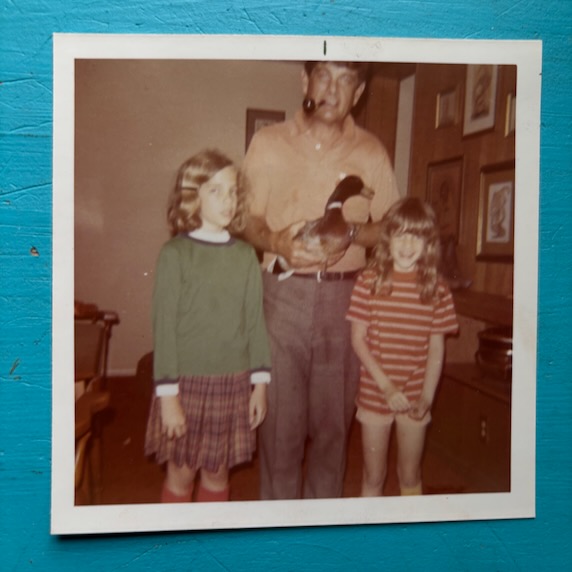
When the notorious trouble-making trio of boys next door were torturing a baby frog by holding a magnifying glass over it to sear it, my friends and I were rescuing a duck who appeared to be lost.
And it was a snow day when we found a dead poodle in the local creek. Together, we three girls hoisted the massive frozen canine out of the icy water with plans to bury it in a front yard bush.
THE CREEK
That brings us to the creek that ran through our neighborhood.
We called it The Creek as if it was the only creek in the world. It was Kid Headquarters. The adults knew of the Creek, but none of them had ever been there or seen it as far as I knew.
We played in the Creek mostly close to our houses. But sometimes, we’d go on a junket as far north as the railroad tracks and as far south as we could trace the creek before the trail went cold, perhaps underground.
On both banks grew thick bamboo, which I now know to be invasive.
We used the bamboo for walking canes and pretend fishing poles and anything else useful. We hollowed out dense patches of stalks to create the inner rooms of huts. We each had our own hut, decorated with trash and pull tabs and bottle glass shards. It was like Gilligan’s Island.
The Creek had a really cool trick.
When it rained, it flooded the banks!
There were metal guard rails running perpendicular to the creek on each side, where it passed under the street through a concrete tunnel. One of our hangouts was to sit on the guard rails and dangle our legs over the side.
On rainy days, we’d be looking over the guard rails in our rains coats with umbrellas, watching the water rise and rise, rushing through the tunnels under the street below.
Once or twice a year, it rained so much that the water crested over the banks entirely and the runoff in the street got ankle deep.
Wow! We said as we stomped in the street. Go Rain! Go Creek!
I don’t know why, but it felt like that was what the Creek was meant to do.
Nature was killing it!
Then one day, an ominous sign went up near the guard rail. It said something about work that was going to happen. It had to do with flood prevention. It was about Creek Control. What a sham!
The City came in with bulldozers. They tore up the Creek. They ripped out the rocks. There was nothing but dirt. We walked along the banks and saw the devastation for blocks.
It hurt to see it hurt this way.
They smoothed it out. They straightened its banks. They laid down forms and rebar. And they cemented it.
It was no longer a creek. It was a concrete ditch. All the life was gone. I wondered what happened to the critters that lived in it. All that was left was just a trickle of water.
The Creek was no more.
One day as it was clouding up to rain, my best friend and I were moping on the guard rails, pondering the bleak setting.
We glared at the drain holes built into the sides to prevent flooding.
Hmm.
We hopped down into the barren crevice with dirt gathered in each fist. We stuffed dirt and sticks in every drainage hole we could find for a block.
Then we waited for the rain.
Later, as we watched from my friend’s front window, the old Creek rose and crested the bank one last time.
Like a funeral for a song bird, the act was our way of honoring something wild and beautiful.
Something that maybe only we knew had been lost.